Around the World with Vertical Farming
 May 11, 2026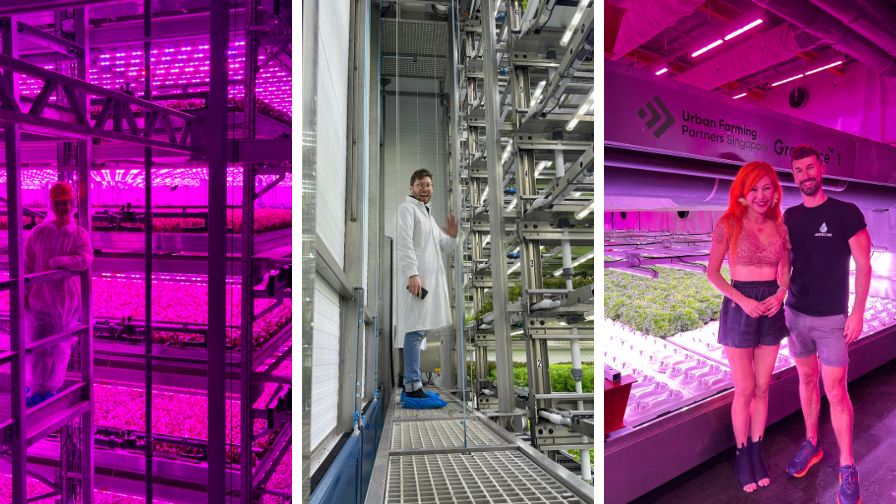
(L to R) 80 Acres Farms in the U.S., Fieldless Farms in Canada, and GroGrace in Singapore. | Henry Gordon-Smith
In 2026, vertical farming stands at a critical inflection point. After several years marked by overextension, high-profile failures, and shifting investor expectations, the sector is no longer defined by rapid growth or capital intensity alone.
Instead, we’re seeing a global recalibration: a reassessment of where vertical farming fits, how it functions, and under what conditions it can thrive. According to the 2025 Global CEA Census, vertical farms remain among the most growth-committed segments in the industry, even as profitability remains inconsistent. Over half of unprofitable operations reported plans to expand—a figure that raises questions about long-term resilience but also reflects a deeper shift from speculative hype to more targeted, mission-driven models.
Across regions, vertical farming is being reshaped by local infrastructure, energy costs, workforce capacity, policy direction, and retail structures. In this global snapshot, I’ll offer a perspective on how key markets are adapting.
U.S.: From Scale to Systems Thinking
The U.S. vertical farming sector expanded quickly from 2018 to 2022, driven by venture funding and the promise of disrupting traditional supply chains. By now, it has confronted the operational realities of that expansion with a boom-and-bust cycle that’s mostly run its course.
Leafy greens—still the dominant crop grown in vertical farming—exhibit the greatest margin volatility among CEA growers, according to the 2025 Census. Many vertical farms lack clear pathways to reduce costs or scale profitably in the face of high energy prices and intense price pressure from field-grown imports and greenhouse competitors.




Major operators like 80 Acres Farms have adopted a more collaborative model than their competitors, working with partners like Siemens and Zayndu to integrate automation and technologies that give them an edge without reinventing the wheel. This suggests a shift toward strategic alliances rather than standalone winner-takes-all thinking.
Meanwhile, other segments of CEA in the U.S., particularly greenhouse growers, are focusing on retrofits and efficiency gains, not new builds. In this evolving environment, vertical farms that emphasize cost discipline, automation, and integrated offtake agreements will be best positioned to endure.
Canada: Policy Stability and Resource Advantages
Canada’s vertical farming industry is smaller in scale but increasingly shaped by national drivers that make local production more viable: food security priorities, geopolitical disruptions in fresh produce imports, and access to renewable electricity.
Canadian operators benefit from more stable policy environments, including clean energy availability in several provinces and emerging procurement models that favor domestic production. These conditions, along with Canada’s high latitude (which reduces competition from open-field leafy green production in winter), make controlled production more relevant and defensible.
What’s more, Canada’s vertical farms often operate with strong institutional linkages, including partnerships with universities, healthcare systems, or provincial innovation hubs. This embeddedness increases their ability to access support, de-risk operations, and pursue longer-term planning.
Asia: Cost Innovation and Urban Integration
Asia continues to demonstrate some of the most diverse and strategically focused vertical farming models in the world.
In Singapore, after a brief pause in government ambitions around local food production, 2026 saw the opening of the world’s tallest indoor vertical farm—a 10-story, fully automated facility that reflects the city-state’s integration of vertical farming into its broader urban resilience strategy.
Japan, meanwhile, is moving from high-volume plant factories toward precision phenotype control, urban integration, and civic utility. As Dr. Eri Hayashi of the Japan Plant Factory Association recently noted, these farms are now hybrid platforms supporting R&D, healthcare, education, and biotechnology.
Across India, Indonesia, and parts of Southeast Asia, smaller-scale vertical farms are proliferating, many using regionally manufactured components to reduce CapEx. Their business models are grounded in solving local food safety and consistency challenges, particularly for leafy greens.
Asia’s primary lesson: Design vertically not for scale, but for specificity. Whether it’s automation in Singapore or modular affordability in India, these models reflect the value of local optimization over global replication.
Europe: Institutional Shift, Market Reality
Europe’s vertical farming trajectory has been turbulent. Since 2022, a wave of closures, particularly in the U.K. and the Netherlands, has exposed the sector’s extreme sensitivity to energy price volatility, which in many cases erased unit margins even in technically sound facilities. This was compounded by tighter financing conditions and limited public subsidies for CEA.
Still, new models are emerging. In Norway, vertical farming company Avisomo’s collaboration with Coop, one of the country’s largest grocery retailers, signals a more integrated approach where vertical farms become part of retailer-owned infrastructure (akin to the historical integration of coffee roasting). By internalizing production, retailers reduce margin pressure while aligning vertical farming with brand, traceability, and ESG objectives.
Italy, too, is an important outlier, with firms like Agricola Moderna achieving traction by aligning with consumer trends, product packaging innovation, and urban retail.
The broader European market may continue to contract in the short term. But as regulatory frameworks evolve and retailer-led models mature, we may see a reconfiguration of how vertical farming scales—not as startups, but as extensions of existing supply chain control points.
Middle East: Infrastructure Without Alignment
The Middle East—particularly the Gulf states—has made some of the most ambitious investments in vertical farming to date, driven by long-term food security strategies and the need to reduce import dependency.
Projects like Bustanica in Dubai, one of the world’s largest vertical farms developed by Bustanica (formerly Emirates Crop One), and others in Saudi Arabia reflect this commitment. However, many regional efforts are constrained by a lack of operational labor, long construction lead times, and inconsistent alignment between government policy and private-sector execution.
Tanja Dedovic, a migration and labor policy specialist with the International Organization for Migration, notes a growing recognition that labor is now treated as critical infrastructure in these projects. Skilled operators, not just systems integrators, are necessary to avoid downtime, inefficiency, and financial underperformance.
Capital deployment has outpaced institutional readiness, creating a gap between ambition and operational performance. Without more deliberate coordination between regulators, financiers, and technology providers, the risk of delays, overspending, and stalled projects will persist, despite strong macro demand signals.
Australia and Latin America: Focused, Urban, Niche
In both Australia and Latin America, vertical farming is less about displacing open-field agriculture and more about serving high-consistency or premium retail needs in urban areas.
Farms like Stacked Farm in Australia and Pink Farms in Brazil are focusing on fully automated or semi-automated systems that target foodservice, premium grocery, or R&D applications. They are not chasing national-scale disruption but instead are positioning vertical farming as a tool for specific high-value crops and high-density regions.
Given energy constraints and more conservative funding environments, this niche strategy is appropriate and pragmatic, especially when paired with automation and a strong product-market fit.
Africa: Structural Mismatch, Misallocated Attention
Africa presents one of the clearest examples of where vertical farming is being promoted in contexts that may not support its long-term viability.
With high levels of arable land, major gaps in basic infrastructure, and significant affordability constraints for most consumers, large-scale vertical farming is not currently aligned with the region’s agricultural priorities. As I shared during a presentation at an urban agriculture conference in South Africa last year, “Africa needs affordable nutrition, not premium technology.”
That doesn’t mean vertical farming has no place in Africa. Vertical farming in Africa is best understood as a specialized tool, not a food-security solution. There are opportunities in educational institutions, luxury markets, and urban R&D hubs. But as a broad solution for food security, vertical farming is misaligned with the continent’s more pressing need for investment in post-harvest storage, irrigation, rural connectivity, and decentralized energy.
Local Design Is the Only Universal Strategy
Vertical farming is not failing. Nor is it universally succeeding. It’s adapting—in different ways, for different reasons, in different regions.
Global evidence consistently shows that viability is defined by context, a foundational planning principle at Agritecture. Markets with supportive energy infrastructure, aligned policy, integrated retail, and trained labor are building the most promising models. Others are struggling, not because the technology doesn’t work but because the system around it is incomplete.
In North America, the strategic lesson is not to retreat from scale, but to pursue it selectively. Successful projects are those designed around local infrastructure constraints, workforce availability, and market absorption capacity rather than replicating capital-intensive models optimized for fundamentally different operating environments.
As vertical farming enters its third generation, success will be measured by how effectively food production is integrated with energy, labor, policy, and demand. Density was the innovation of the first wave; integration will define the next.
Editor’s note: This article was originally published in our 2026 Industry Report: Vertical Farming.