Research Brief: Breeding Resilient Vegetable Crops
 June 25, 2025
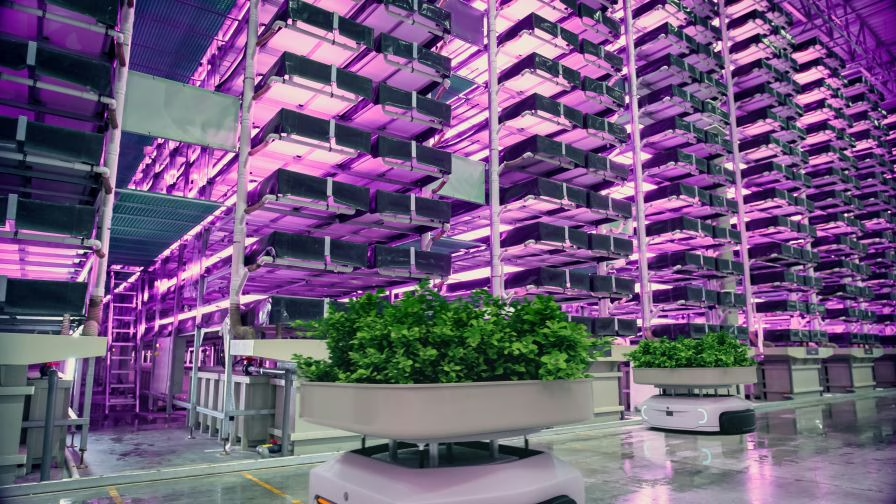
Greens growing in an indoor farm. | Photo courtesy of Unsplash
Several researchers at North Carolina State University (NC State) are using speed breeding to accelerate the development of more resilient and productive crops, including lettuce, soybeans, and peanuts. This approach significantly reduces the time required to complete a seed-to-seed cycle, enabling faster integration of desirable traits such as improved stress tolerance, nutritional value, and yield potential.
Ricardo Hernandez, Ph.D., assistant professor of CEA and head of the CEA Coalition, leads the study. “We’re using science and technology in controlled environments to speed up the integration of new traits into crops,” he says.
The NC State team focuses on two main components of the speed breeding process: Gene integration and plant multiplication. Dr. Hernandez and his graduate students are using controlled environments to improve the efficiency of both.
“By controlling environmental factors, we can improve the efficiency of gene integration,” he says. “And through tissue culture, we can produce large numbers of genetically uniform plants in a shorter period and at lower cost.”
Once the genetic work is complete, the plants are transferred to growth chambers to deploy treatments. This includes changing the lighting, CO2 diffusion, and air exchange to see how the plant responds and determine whether they have the “desirable traits” a breeder is looking for.

Another approach in speed breeding is accelerating flower and seed production. The plant life cycle, from vegetative growth through flowering to seed production, is strategically manipulated under controlled conditions. Since plants produce seeds once they reach the flowering stage, breeders want to get there as quickly as possible so they can integrate new genes into the seeds.
“Breeders want to get to that flowering stage fast,” he says. “We’re using controlled environments to reduce the time to flowering and, in turn, breeders can accelerate the integration of new traits into their crops quickly.” This enables multiple breeding generations per year, a critical advantage for developing improved crops.
“The number one way to be resilient is to integrate new traits into your breeding,” Dr. Hernandez advises. “A lot of our improvement in food production comes from genetically improving the plant, and that has to be done through continuous breeding.”