What’s New in the Field of Greenhouse Lighting?
 October 15, 2025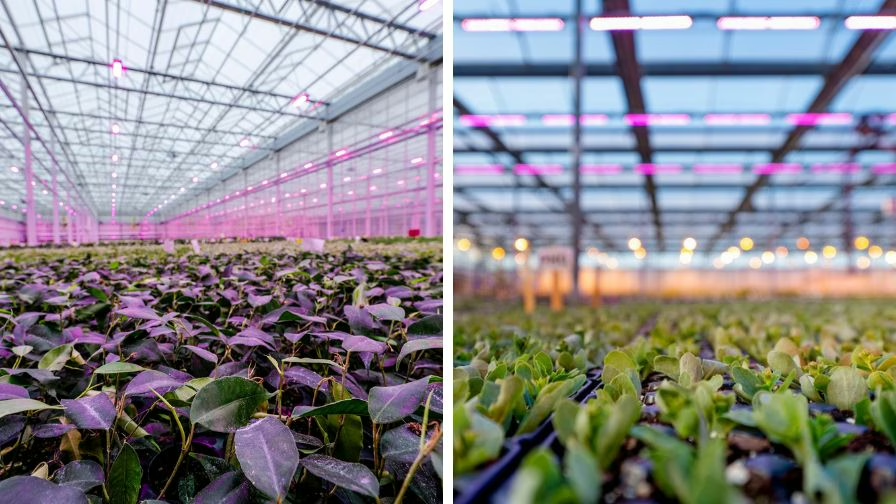
Signify dynamic lighting at The Plant Company (L) and Walters Gardens (R). | Photo courtesy of Signify
What counts as “new” in greenhouse lighting is always shifting. A few years ago, LEDs were the headline. Today, the conversation has moved to dynamic spectrum control, artificial intelligence (AI), and even under-canopy or pulsed LEDs. As with most technology, adoption spans a wide spectrum. Some growers are running cloud-based subscription systems that automate every lighting need. Others still walk in each morning, flip the switch, and listen to their high-pressure sodium (HPS) lights hum to life. In the end, what’s new depends on the system you’re currently using.
We spoke with experts from Sollum Technologies and Signify, two leading suppliers in the lighting space, to learn what growers are asking, how they assist growers in navigating lighting innovations and upgrades, what new developments are currently available, and what’s coming next.
Top Concerns from Growers
Money is always top of mind. Growers want to know: What’s the ROI, and how much will I save on energy costs? While LED lighting has been part of the conversation for years, many operations are still transitioning. For some growers, replacing aging HPS systems isn’t just about energy efficiency anymore, it’s about necessity. Parts are harder to find, replacement lights aren’t available, and new efficiency standards are forcing change.
Growers who don’t run lights year-round have been slower to shift, unsure of the benefits. Many worry about losing the heat generated by legacy HPS systems and aren’t confident about how to use new LEDs or which lighting recipes to follow.
“A lot of growers have shared concerns about losing the heat from HPS,” says Abhay Thosar, chief horticulture specialist at Sollum Technologies. “It’s one of the top concerns we hear, and it’s something we have demonstrated to growers. If the HPS fixtures are positioned more than six feet above the crop canopy, they have no impact on the plant temperature. We’ve done side-by-side measurements with LEDs and HPS at six or more feet above the foliage, and there is no difference in plant temperature. It’s a myth that using HPS makes the plants grow warmer.”

Energy efficiency remains another driver. Many operations still relying on HPS are not only overspending on electricity but also underlighting their crops. “For every watt of power going into the HPS fixture, less than 40% of that is being turned into growth-stimulating light, and as much as 60% of the energy is put out as heat,” says Dan McMahon, Signify Key Account Manager. That’s why LEDs, with much higher efficiency, are important. Growers can realize 40-50% energy savings from an upgrade. Not only are there energy savings with LEDs, but growers can supply more light using a lower amount of power. “The ROI, from an efficacy standpoint, is not a direct swap because we’re increasing the supplemental moles of light into the greenhouse and improving growth.” McMahon also notes that many ornamental growers transition to LEDs gradually rather than replacing their entire system at once.
Comprehensive Support and Training for Growers
Growers need a vendor who understands their needs, but they also need training and support. Lighting is a significant investment, and transitioning from HPS to LED also requires a substantial adjustment.
“Quite often, the conversation starts by finding out what their pain points are, whether it’s a germination issue, rooted cuttings, low light conditions, or simply looking for ways to maximize production and greenhouse space,” says John Burns, key account manager at Signify. To meet those needs, Signify uses a customer-focused “triangle” support model that brings together key account managers with growing expertise, plant specialists, and lighting application engineers. “We support growers with holistic solutions; we don’t just sell a luminaire.”
For some growers, there’s a lot to catch up on, and that’s where a strong relationship with their supplier really pays off. Thosar says he often spends time educating growers when they call.
“A lot of these growers still measure light in either watts per square meter or lumens. There are even some who still talk about foot-candles,” he says. “None of these measurements are for photosynthetic light (PAR).”
Thosar emphasizes that growers need to understand daily light integral (DLI) and its units of measurement, moles per day, as the true benchmark for plant growth.
Growers should look for LED systems that offer flexibility not just in intensity or dimming, but also in spectrum control and zoning. “It’s one of the things we need to educate the growers on,” Thosar explains. “We ask questions about their needs, even pointing out in their own greenhouse that they are growing a petunia right beside impatiens, and both have different light requirements. If you provide just one light for both, it’s not going to be optimal. Once you point it out in the greenhouse, it starts making sense for them.”
What’s “New” in Greenhouse Lighting?
Dynamic LED fixtures that allow growers to adjust the spectrum of light aren’t brand-new to the market, but their adoption across the greenhouse industry is accelerating. For years, fixed spectrum, on/off fixtures have been the standard, and while they still work, but the future is clearly moving toward fully controllable systems. These newer LEDs can be customized for both spectrum and intensity, and when paired with AI-driven controls that adjust in real time, they open the door to a new level of precision and efficiency.
To learn more about the latest innovations in greenhouse lighting, read the full article on GreenhouseGrower.com