2025 Emerging Leader Finalist: Gretchen Schimelpfenig
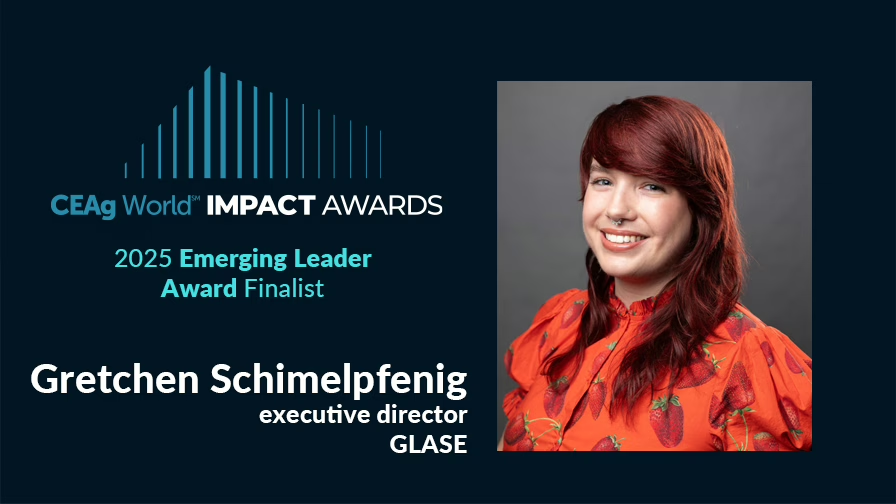
Gretchen Schimelpfenig is one of three finalists in the Emerging Leader category of the inaugural CEAg World Impact Awards.
 Gretchen Schimelpfenig of GLASE and Energy Resources Integration is one of three finalists in the Emerging Leader category of the inaugural CEAg World Impact Awards. The Emerging Leader Award recognizes a rising talent in CEA who demonstrates exceptional promise and leadership with new solutions, strategic thinking, or leadership within their community or industry. This award recipient will be someone who drives change through the adoption of cutting-edge technologies and ideas that enhance productivity, sustainability, and efficiency, shaping the future of agriculture. Learn more about Schimelpfenig below, and watch CEAgWorld.com for more profiles of our finalists.
Engineer Gretchen Schimelpfenig is committed to improving the CEA industry by maximizing energy efficiency while maintaining crop productivity. She was exposed to controlled environment agriculture early in her career, when the commercial cannabis market was legalized in her home state of Vermont.
While working at the Burlington Electric Department, she helped develop resources for growers, hosted a “Know Your Grow” event, and launched the first LED grow light rebate program for CEA cultivators in the state.
The more she learned about the global energy impacts of indoor agriculture, the more concerned she became. She realized that there are many ways her engineering skills could help commercial growers across the country, and decided to work full-time in the CEA industry, including produce.
Today, Gretchen serves as the executive director of the Greenhouse Lighting and Systems Engineering (GLASE) consortium as well as senior energy engineer with Energy Resources Integration (ERI).


“Indoor farms and greenhouses need to access efficient technology to use less energy while increasing production,” Schimelpfenig says. “I believe that rising energy prices will become a larger economic pressure on CEA businesses in the coming years and efficient farms will be the only competitive option.”
Building Trust Through Relationships
While still working at the Burlington Electric Department in 2018, Schimelpfenig began contributing to the Resource Innovation Institute (RII) as a Utility Working Group member. She joined the organization, a not-for-profit focused on advancing resource efficiency in agriculture and related fields, full-time in late 2019 as its technical director. Here, she managed the PowerScore online benchmarking tool, virtual webinars, and many best practices guides.
In 2022, she was hired by ERI to focus on CEA business services and research. The following year, Schimelpfenig also took on the role of executive director of Cornell University’s GLASE consortium. Through GLASE, she spearheads initiatives aimed at collaborative research and commercialization of advanced lighting, HVAC, and environmental control systems, accelerating technology adoption across greenhouses and vertical farms.
In a rapidly changing industry like CEA, Schimelpfenig says, it’s critical to build trust through relationships. Good leaders inspire others to join their cause, she says, and to that end she seeks to demonstrate how energy efficiency benefits everyone.
“When I share my knowledge with the market, I give good information without expecting anything in return,” she says. “Growth requires community, not ego and individualism. I build connections and partner with diverse people because inclusion makes us stronger.”
Schimelpfenig publishes studies with utility industry partners like California’s Energy Transition Coordinating Council and contributes to media outlets with highlights of her work in research and energy efficiency. She enjoys connecting with her professional network in person at conferences and speaking at events. She often appears on industry podcasts and shares her career story with engineering students as a guest speaker at the University of Vermont and Clarkson University.
Workforce Development
Workforce recruitment and retention are also keenly important to Schimelpfenig’s CEA goals. She helped GLASE launch CEA Works, a series of training resources, in June 2025 in collaboration with several academic partners. In 2026, CEA Works hopes to award certificates to 500 attendees for its courses on crop production, plant physiology, rootzone management, and business planning.
Schimelpfenig is also leading an initiative at GLASE to develop a curriculum for middle and high school students to prepare them for careers in ag tech through a USDA-funded project called E-GROW. In 2026, E-GROW will work with its academic and youth development partners to develop a library of new, self-paced online and interactive educational tools and modules for students at 10 pilot schools in New York, Pennsylvania, Virginia, and Wyoming.
Schimelpfenig sees a huge opportunity for the CEA industry to expand recruiting and hiring practices to be more inclusive. She leads Vivid Canopy at GLASE, an initiative bringing together industry professionals to build diverse networks and amplify job opportunities for growing careers.
“At Vivid Canopy events, all are welcome! We gather attendees at conferences to have open conversations about improving the CEA workforce,” she says.
Again, it comes back to relationships and leading by example.
“I’ve created a network of partners across the globe who are my allies. They trust me to bring the real results without a filter,” she says. “Because I’m a credible source of knowledge, my network brings me into exciting opportunities and opens doors for me.”
The winners of the CEAg Impact Awards will be announced and honored live on stage at the kickoff ceremony for the CEAg World Conference and Expo on Nov. 20, 2025, in Durham, N.C. To learn more and join us at the conference (growers attend free if registered by Oct. 31), visit CEAgWorld.com/events.