2025 Innovator Finalist: Moein Moosavi-Nezhad
 November 6, 2025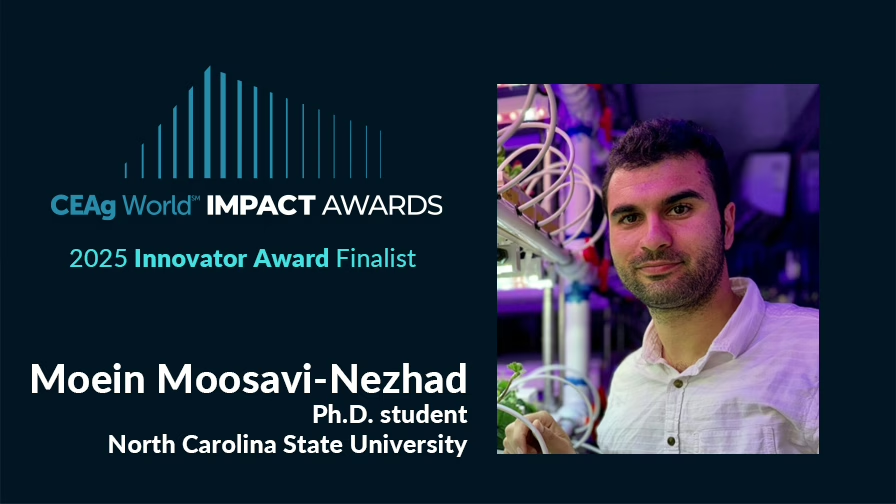
Moein Moosavi-Nezhad is one of three finalists in the Innovator category of the inaugural CEAg World Impact Awards.
 Moein Moosavi-Nezhad, Ph.D. student at North Carolina State University, is one of three finalists in the Innovator category of the inaugural CEAg World Impact Awards. The Innovator Award recognizes an entrepreneur or leader who has pioneered and implemented a new tool, concept, or practice that has significant implications for CEA. This award recipient will be someone who has used their expertise to drive tangible improvements for growers, enhancing productivity, sustainability, and overall farm success.
Learn more about Moosavi-Nezhad below, and watch CEAgWorld.com for more profiles of our finalists.
Moein Moosavi-Nezhad grew up on a farm in Iran, watching his parents work the land with traditional flood irrigation methods. Even as an elementary school student, he knew he wanted to pursue farming, too—he just wanted to do it better.
That childhood determination to advance agricultural practices has led Moosavi-Nezhad to achieve something that’s turning heads across the CEA industry. Working in Ricardo Hernández’s lab at NC State, the third-year doctoral student developed a vertical propagation system for strawberry plants that produces 1,200 to 1,500 daughter plants per square meter—dramatically outperforming the 70 to 100 plants per square meter typical in open-field nurseries and exceeding current CEA benchmarks. His accomplishments earned him the 2025 ASHS Outstanding Graduate Horticulture Student Award from the American Society for Horticulture Science.
Solving Real Industry Problems
The path to this breakthrough began with a significant challenge facing the U.S. strawberry industry: a lack of clean, disease-free planting material. California growers rely heavily on methyl bromide—a powerful soil fumigant used to kill pathogens, nematodes, and weeds before planting—but with tightening regulations on the horizon due to its ozone-depleting properties, the industry needs alternatives. Even with current fumigation practices, young strawberry plants transported from nurseries to production fields often carry latent diseases that emerge during fruiting, after growers have already invested substantial resources.



His research, part of a USDA grant involving 11 institutions, tackles this problem by moving strawberry propagation indoors and growing it vertically. In open fields, strawberry runners—the plant’s natural vegetative reproduction shoots that extend horizontally from the mother plant—crawl along the ground, making contact with soil, which is a primary source of infection. Moosavi-Nezhad’s system keeps mother plants elevated with runners cascading downward, eliminating soil contact entirely.
The challenge? Strawberries don’t behave like any other CEA crop. “You have lettuce and radishes that are small with no complex architecture. You have tomatoes and cucumbers that are tall like a tower,” he explains. “But strawberries are like a reversed cone—mother plants on top with a really high leaf area index blocking the light, then primary, secondary, and tertiary runners. We didn’t know how to treat them so they’d behave like those other plants.”
Methodical Optimization
Moosavi-Nezhad has taken a systematic approach to solving this puzzle. Over five experiments, he optimized multiple environmental factors: photoperiod (achieving an 18% yield increase by shortening the light cycle), light spectrum, increasing planting density, and optimizing the distribution of light between overhead fixtures and intercanopy lighting positioned within the plant layers. Critically, he achieved these gains without increasing total light—and therefore energy costs.
“We didn’t actually provide more light because that means more energy and more costs,” he says. “We substituted part of the top light with intercanopy lighting with different recipes. And with the same daily light integral, we got these amounts of daughter plants in a really compact system.”
Equally important: quality and uniformity improved along with quantity. In open fields, the first daughter plant closest to the mother grows too large to use, while the last is often too small; both must be discarded. “In a compact density, because we have daughter plants through more runners, the uniformity of the growth system is better,” Moosavi-Nezhad says.
Looking Beyond the Lab
Moosavi-Nezhad is finishing his statistical analysis and writing now, targeting a May 2026 completion date. He hopes to land a research-focused position in academia or R&D.
He’s also written a grant proposal on sustainability assessment because, he says, “Right now, I can promise growers clean daughter plants and increased yield. But I can’t promise that open-field growers will achieve better profitability when they invest in our system.”
That practical mindset informs his vision for future research: testing more strawberry cultivars, refining environmental controls that affect the trade-off between runner and flower production, exploring disease prevention through environmental manipulation, and integrating artificial intelligence (AI) for prediction and automation.
“I think CEA has great potential,” Moosavi-Nezhad says. “Some people think that CEA just means optimizing the environment. But it’s more about controlling it. Sometimes we want to trigger plants with UV lights or with high EC (electrical conductivity) in the nutrient solution, to make the plant feel a little stress and produce secondary metabolites. That kind of research really interests me.”
The winners of the CEAg Impact Awards will be announced and honored live on stage at the kickoff ceremony for the CEAg World Conference and Expo on Nov. 20, 2025, in Durham, N.C. To learn more and join us at the conference, visit CEAgWorld.com/events.