Research Brief: Growing Fruit Without Roots or Light
 January 20, 2026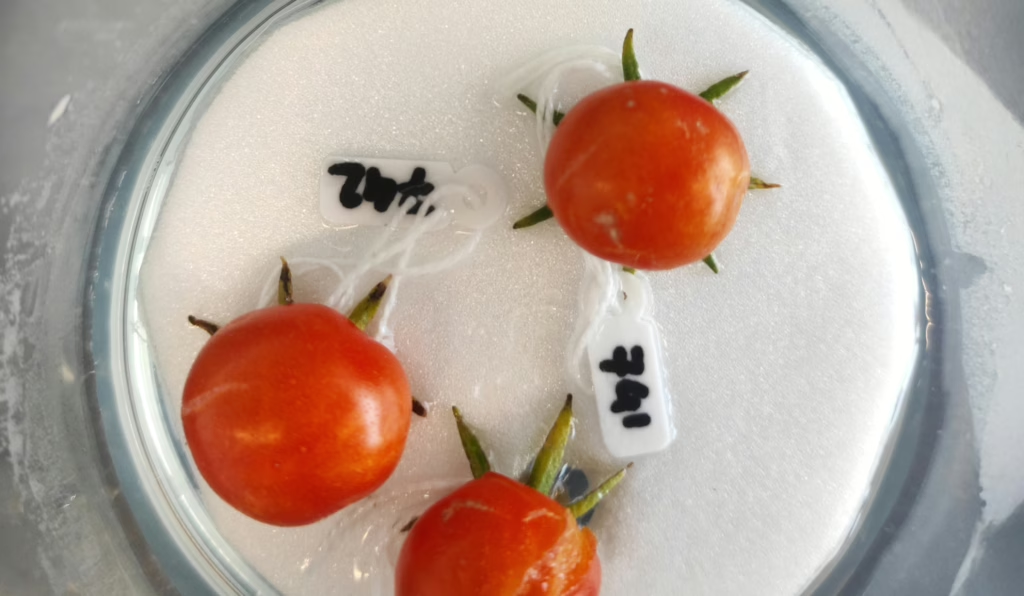
New research from Wageningen University and Research (WUR) suggests that fruit could be grown to completion without roots or light. | Photo courtesy of WUR
Lucas van der Zee, a Ph.D. student at Wageningen University and Research (WUR) in the Netherlands, demonstrated in March that it’s possible to grow tomato plants from the cellular level up—without light—for a research project dubbed Fruit of Knowledge. With supporting research from Niels Peeters of Utrecht University, whose work focused on inducing flowers from the stem cells of a plant, van der Zee is now able to produce a fruit using sugar, water, a nutrient solution, plant cells, and a few simple mechanical systems (pumps and fans) to facilitate growth.
Van der Zee is using tomato plants for his current experiments. To begin the process, he treats the plant tissue (which is sourced from a seed or embryo) with cytokinins (plant hormones), to develop the meristem of the plant, which is the stem cell zone responsible for new organ growth. The meristem then starts to flower using its own hormonal cues and begins growing fruit on its own after it has been pollinated. The developing fruit is then moved to a sugar-and-nutrient medium, absorbing the nutrients it needs through its cut stalk. This process reduces both energy costs and the resources needed to grow a plant to completion.
Right now, the tomatoes produced in van der Zee’s system are exceptionally small: just the size of a blueberry. However, they still taste like tomatoes grown in typical CEA systems and outdoor fields. Moving forward, his research will focus on growing larger fruit. In an effort to achieve this, he has kept the stem attached to the tomato in some scenarios to improve nutrient uptake.
While lowering energy costs is a critical piece of his research, van der Zee’s top priority is designing CEA systems that require the simplest growing conditions to produce quality fruits and vegetables.
Editor’s note: This article was originally published in our 2025 Industry Report: State of the CEA Industry.