Research Brief: Plasma Activated Water Shows Major Potential
 January 27, 2026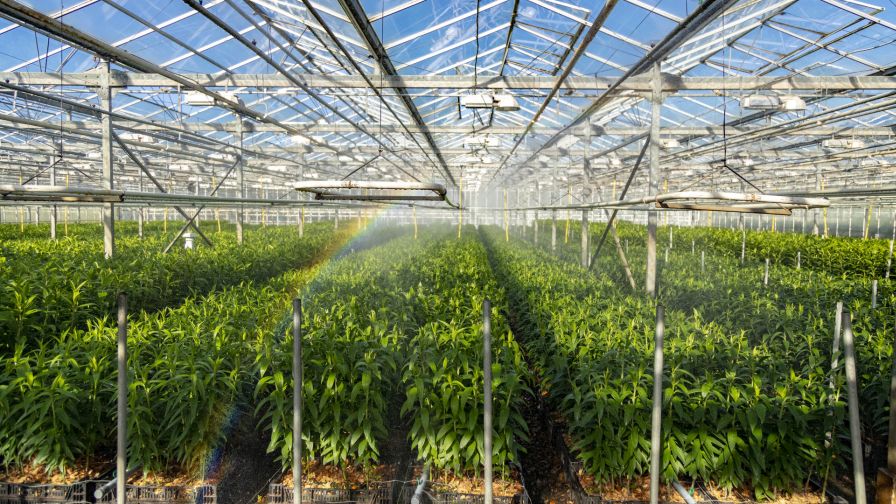
Interior greenhouse irrigation and environmental controls. | Photo courtesy of Hortica
A paper describing the properties and benefits of plasma activated water (PAW) was published in the journal Crops in June 2025. Two of its authors, Drs. Neil Mattson (Cornell University) and Nathan Eylands (the University of Minnesota), detailed the implications for CEA in conversations with CEAg World two months prior to publication.
As Dr. Eylands puts it, PAW is equivalent to “lightning striking a body of water.” Plasma, an aggregation of high energy particles with chemical activity, is injected into water to elicit a reaction between the atmosphere and water. “We generate a bunch of reactive oxygen and nitrogen species like hydrogen peroxide, nitrite, ammonia, nitrogen, and all these interesting compounds that are then dissolved into the water,” he says.
Those reactive oxygen species (like hydrogen peroxide) offer sanitizing effects for irrigation lines and equipment; they can also be used to soak seeds. Dr. Mattson’s research also suggests that PAW produces biostimulant effects on plants so they can better defend against pests and disease. “PAW could be part of a system’s approach for growing plants in controlled environments where it improves plant fertility,” he says.
But perhaps the most notable benefit of PAW is that it could qualify for organic production if it’s generated on-site. This would be a major win for the industry, as there aren’t many organic sources of plant-available nitrogen.
“We call [PAW] the Swiss army knife of agriculture because we have seed germination properties, we’re seeing seedling vigor increase, and we’re seeing pesticide applications,” Dr. Eylands says. “We’re seeing all of these enhanced benefits within the plant system … And there are things we haven’t even explored yet.”



At this point, Dr. Mattson says, the equipment needed to produce PAW is expensive and can only produce small amounts at one time.
“It isn’t ready to be used on a commercial scale,” he explains. “I would say using PAW at the seedling stage when low volumes are required seems like a good fit right now unless we get more affordable, industrial type equipment in the near future.”
Both researchers agree that more study is needed before PAW can be used on a broader scale. “I always compare it to LED lighting,” Dr. Eylands says. “Growers knew it had benefits, but it took a while for them to implement it in their operations.”
Editor’s note: This article was originally published in our 2025 Industry Report: State of the CEA Industry.