Expanding Crops for Vertical Environments
 June 1, 2026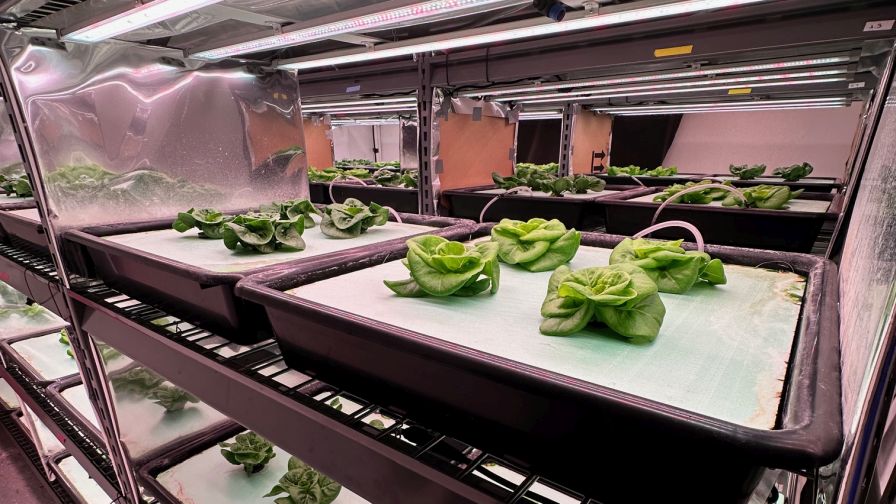
Photo: University of Georgia
University of Georgia — Reducing Lettuce Tip Burn
Lettuce tip burn, a physiological disorder linked to calcium deficiency in rapidly expanding leaf tissue, continues to be a major source of crop loss for vertical farms. In a new University of Georgia (UGA) study, researchers Parker Egan Persons, Paul M. Severns, Anish Malladi, and Rhuanito Soranz Ferrarezi examined how downward airflow management can reduce tip burn risk, even under high light levels used to drive faster growth and higher yields.
The two-season study evaluated four downward airflow rates and three light intensities to simulate a broad set of conditions producers utilize in their facilities. The study used two commercially relevant lettuce cultivars: the tip burn-tolerant butterhead ‘Casey’ and the more sensitive romaine ‘Dragoon.’
Researchers assessed tip burn severity, marketable yield, plant water use, biomass, and quality parameters across full production cycles.
“Our goal was to test if increasing airflow would reduce tip burn since the cost associated with maintaining high airflows in vertical farms is still high,” says Ferrarezi, Associate Professor of CEA Crop Physiology and Production at UGA.
Higher light levels increased photosynthesis, biomass, and quality indicators such as chlorophyll and soluble solids, but also led to greater tip burn incidence in both cultivars, as expected. By contrast, increasing downward airflow consistently reduced tip burn severity and raised the percentage of marketable plants, without negatively affecting yield or tissue nutrient concentrations.


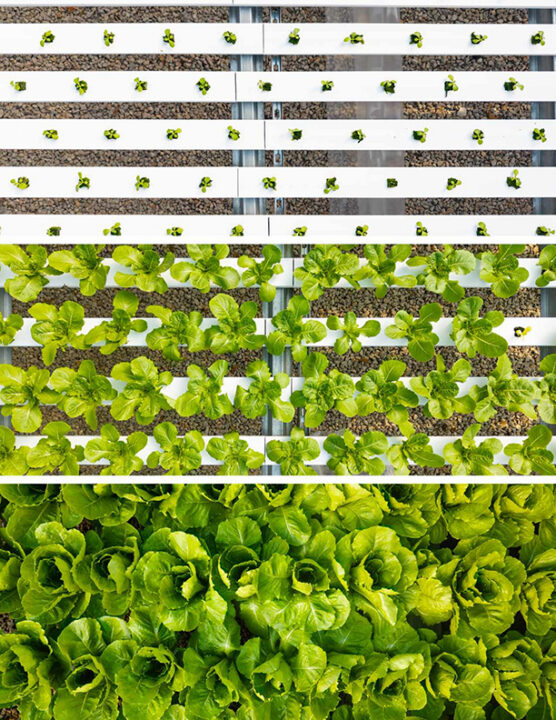

The effects of light and airflow were statistically independent, meaning airflow did not change how plants responded to light but did influence how much tip burn developed at any given light level. In both cultivars, airflow rates above 0.7 m·s⁻¹ were associated with substantially lower tip burn, while the highest airflow treatment (1.3 m·s⁻¹) produced the greatest share of marketable plants, particularly under higher light.
The authors attribute the results to improved transpiration within the dense lettuce canopy and higher calcium uptake. Downward airflow reduces the stagnant boundary layer around young leaves, allowing more efficient water movement through the plant and improving calcium transport to developing tissue.
For CEA lettuce operators, the findings suggest that airflow design may play a significant role in balancing light-driven yield gains with crop quality under intensive production conditions.
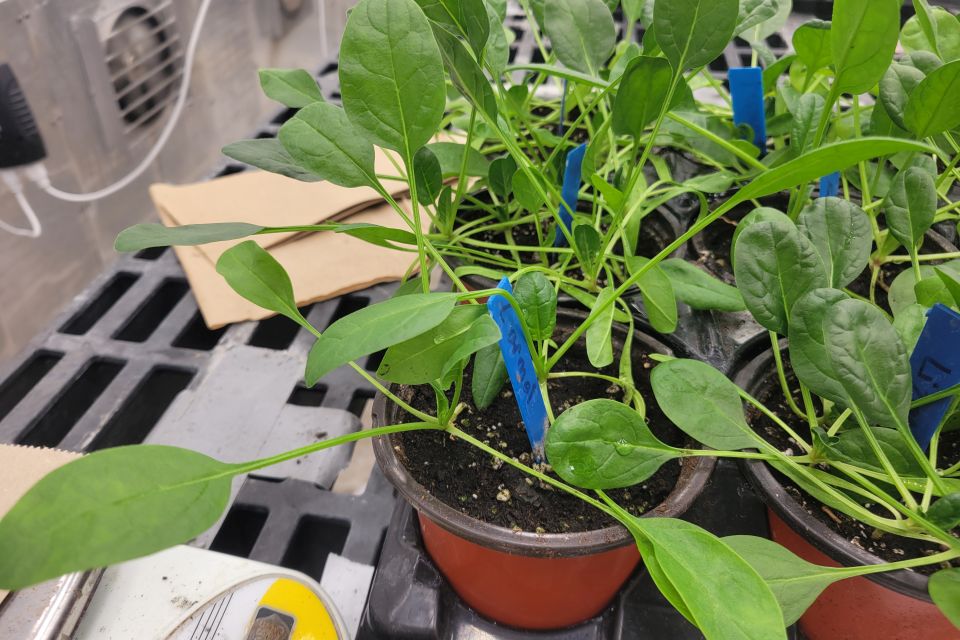
Photo: Cornell University
Cornell University — Optimizing Spinach
Spinach has long been considered a difficult crop for vertical farms, largely due to uneven germination, limited cultivar optimization for indoor systems, and sensitivity to root diseases. New research from Graydon Yoder, Nick Kaczmar, and Dr. Neil Mattson of Cornell University evaluates whether improvements in seed handling, cultivar selection, and lighting strategies could help address these challenges in controlled environment agriculture (CEA).
The study examined five commercially available spinach cultivars—‘Auroch,’ ‘Carmel,’ ‘Lizard,’ ‘Space,’ and ‘Sunangel’—grown under controlled conditions. One focus was a multi-step seed pretreatment process designed to improve early establishment. The protocol included a brief soak in a diluted bleach solution to reduce pathogens, followed by aerated water and a short hydrogen peroxide germination phase. Across cultivars, treated seeds showed higher survival rates, larger leaf area, and greater fresh weight at harvest compared with untreated seeds. Gains were especially notable in ‘Carmel,’ a cultivar known for slower or less consistent germination.
Researchers also compared growing media and found that while rockwool made early germination easier to observe, seedlings grown in a peat-based soilless potting mix developed stronger roots and more robust foliage. As a result, potting mix was used for subsequent trials.
Lighting experiments evaluated two daily light integral (DLI) levels—a measure of the total amount of usable light plants receive each day—combined with varying levels of supplemental far-red light (which were provided by Rayn Growing Systems). Far-red light (700–750 nanometers) sits just beyond the visible spectrum and has been shown to boost yield in some leafy greens, such as lettuce. In spinach, however, adding far-red did not increase fresh or dry weight. Instead, it caused longer leaf stems (petiole elongation), particularly under lower light conditions, a response associated with plants stretching to capture more light.
For vertical farms, the findings suggest that spinach performance is driven more by consistent seed treatment, cultivar choice, and sufficient overall light levels than by far-red spectral additions. Improving early-stage uniformity may offer the most practical path toward integrating spinach into indoor production systems.
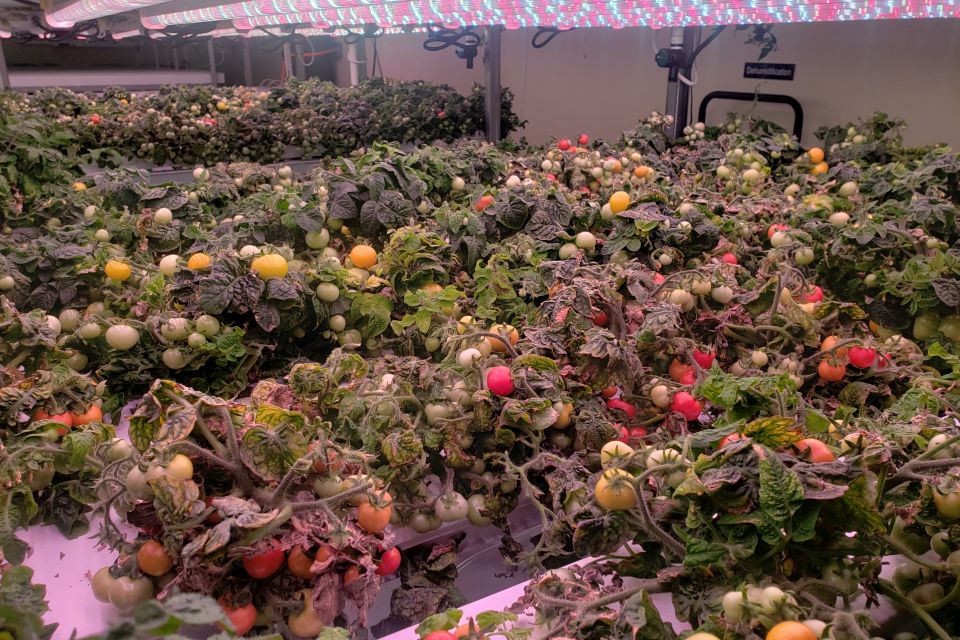
Photo: Virginia Tech
Virginia Tech — The Potential of Microtomatoes
Researchers at Virginia Tech and partner institutions are taking a closer look at whether microtomatoes could become a viable crop for indoor vertical farms. In a study that was recently published in the journal HortTechnology, Anna Ekene Tharpe, Kaylee A. South, Scott Lowman, Brandan Shur, and Michael R. Evans evaluated how different microtomato cultivars respond to varying light intensities in a near-commercial vertical rack system.
The team tested seven commercially available micro- or “super-dwarf” tomato cultivars to see whether they could physically fit within the limited headspace typical of vertical farms. Despite being marketed as compact, about 25% of the cultivars grew too tall for standard rack spacing. Three cultivars—‘Micro Tom,’ ‘Venus,’ and ‘Jochalos’—met height requirements and were selected for further trials.
Plants were grown hydroponically using a nutrient film technique (NFT) system. Researchers then compared performance under three photosynthetic photon flux density (PPFD) levels: 260, 350, and 430 µmol·m⁻²·s⁻¹. PPFD refers to the amount of light plants receive for photosynthesis and is a key driver of yield and quality in indoor farms.
Across cultivars, higher light levels generally led to shorter plants, earlier flowering, and greater total fruit weight. Yield responses varied by cultivar, however. ‘Micro Tom’ produced more fruit as PPFD increased from 260 to 350 µmol·m⁻²·s⁻¹, but saw no additional gains at higher light levels. ‘Jochalos’ delivered the greatest total fruit weight overall, while ‘Venus’ lagged behind in both yield and fruit count.
Fruit quality also improved with more light. Soluble solids content, measured as degrees Brix (a common indicator of sweetness) increased as PPFD rose. Still, the researchers noted that the modest Brix gains at the highest light level may not justify the added energy costs for commercial growers.
Based on the results, the study recommends a PPFD of about 350 µmol·m⁻²·s⁻¹ for indoor vertical production of microtomatoes. For growers considering crop diversification beyond leafy greens, the findings suggest microtomatoes could be feasible, but only with careful cultivar selection and realistic lighting targets.
Editor’s note: This article was originally published in our 2026 Industry Report: Vertical Farming.