Managing Root Disease in Hydroponic Lettuce
 August 1, 2025
CEAg World Session Spotlight
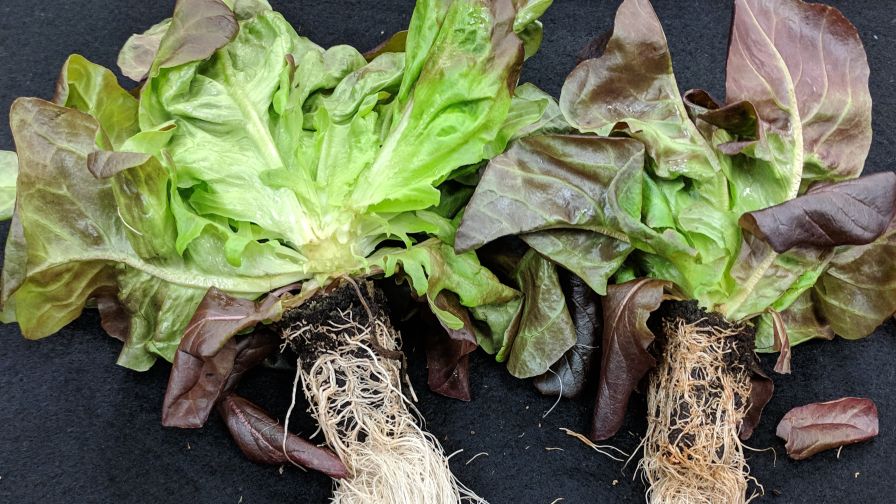
Healthy lettuce plant (left) and Pythium-infected plant (right). Note the root discoloration and smaller head in the infected lettuce. | Photo: Anna Testen
Root diseases may be the last thing you want to think about in leafy green production, but diseases can quickly derail even the most successful growers. Pythium and its close relative Phytophthora, also called oomycetes or water molds, reproduce quickly, move rapidly, and survive well in hydroponic systems. Pythium root rot is the most challenging disease in these environments, but other diseases caused by Phytophthora, Berkeleyomyces (formerly Thielaviopsis), or Fusarium species may also affect your plants. These disease issues should be addressed proactively as they can be persistent and difficult to manage consistently.
Pythium root rot symptoms vary by crop, plant age, Pythium species, and environmental conditions. Generally, plants infected with Pythium will have reduced root vigor and root discoloration ranging from pale yellow to dark brown. Leaves may be stunted, yellowed, or wilted if roots are heavily affected. Certain Pythium species can infect crops without causing symptoms or can cause subtle symptoms, like root tip dieback.
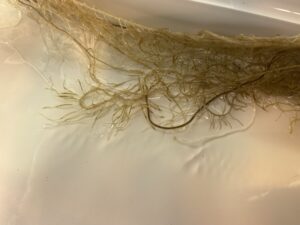
Root discoloration and root vigor in Pythium-infected spinach. | Photo: Anna Testen
What Should I Do First?
If this is your first encounter with a root pathogen in your hydroponic system, it’s well worth sending a sample to a plant diagnostic clinic to identify the pathogen. A wrong disease diagnosis can waste resources and time for disease management. If your operation has dealt with Pythium root rot before, you don’t need to send samples for diagnosis unless you notice changes in the crops affected or in symptom appearance, severity, or timing. These changes could indicate the presence of a new Pythium species or additional pathogen, such as Phytophthora.
There is no silver bullet for Pythium disease management, but with time and experimentation growers can develop a toolbox of approaches to reduce the impacts. Your disease management toolbox against Pythium root rot includes water treatments, sanitation, selecting disease tolerant varieties, cultural practices such as manipulating environmental conditions, and biological controls. It’s important to employ multiple approaches: Layering different strategies ensures that weaknesses in one approach are bolstered by the strengths of another.


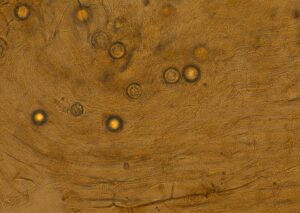
These Pythium spores are approximately 50,000 times smaller than the period at the end of a sentence. | Photo: Anna Testen
Tailor Your Approach to Your System
The diversity of hydroponic production systems makes it difficult to make uniform disease management recommendations to all growers, but some basic principles hold true across operations.
Preventing disease outbreaks in the first place should be a key priority, with sanitation and water treatment practices and plans in place. Pythium can enter and spread in hydroponic operations through many avenues, including irrigation water, insects (such as fungus gnats and shoreflies), workers’ boots and clothing, dirt and dust, and growing substrates. Sanitation practices, such as footbaths, can reduce the risks of introducing Pythium and other pathogens.
Use of sanitizers is essential in hydroponic production and there are many active ingredients for a grower to choose. Make sure sanitizers are being used correctly, as factors such as pH, temperature, contact time, and relative humidity all affect how well they kill pathogens. Between cropping cycles, surfaces should be scrubbed then sanitized. Scrubbing is essential prior to sanitization because biofilms, organic matter, and salt crusts all reduce sanitizer effectiveness. Replaceable hydroponic components, such as tubing or Styrofoam rafts, should be replaced between cropping cycles if economically feasible.
There are chemical, physical, and biological water treatments that can be applied in hydroponic operations. Selecting which one works best for your operation will depend on your water source, cost, physical limitations of your system, and goals of the treatment.
Cultural Production Practices
Use of sound cultural production practices is pivotal for reducing the impacts of Pythium root rot. Focus on growing a healthy crop by following good production practices: producing healthy seedlings, ensuring a proper growing environment, and avoiding plant stress. Variety selection is one of the most important choices a grower can make, and it can be difficult to balance production needs with consumer desires. While no Pythium-resistant varieties are currently available on the market, many growers have found varieties that are tolerant to Pythium. It takes experimentation to find these varieties but talking to other growers and seed company reps can help get a jumpstart on identifying which varieties work best.
Healthy seedling production is a priority as Pythium can be present in propagation areas, and disease severity increases the earlier that plants are infected. The growing environment has a tremendous impact on plant health and the progression of Pythium root rot. Some varieties may tolerate environmental stresses in your operation better, potentially reducing Pythium damage. Many growers have indicated more severe Pythium root rot following stress events, such as exposure to temperature extremes. These stresses are sometimes unavoidable, but following a stress event, closely watch your crop for disease onset.
Researchers have explored how manipulating the growing environment can reduce Pythium root rot. Pythium species are very sensitive to temperature, with some species growing better in cooler nutrient solutions and others growing better in warmer nutrient solutions. Adjusting nutrient solution temperature is a temporary fix to support plant growth over pathogen growth but should not be relied on for too long, as other Pythium species may become an issue.
Microbial biopesticides, also known as biological controls or biologicals, should be used as a preventive treatment for root disease, not a bandage once disease is present. As biopesticides are usually a living product, extra care is required to improve effectiveness and consistency. When applying biologicals, focus on treating the plant, not the hydroponic system. Efficacy is improved when the product contacts the plant. Make sure biologicals are properly stored according to the label to avoid product degradation.
Consult Your Peers
Talk to other growers, Extension educators, crop consultants, and plant pathologists about what they’ve found works best for managing Pythium root rot. Dealing with Pythium root rot can be a major challenge, and it helps to have experienced allies. For a more detailed description of Pythium root rot symptoms, hosts, and diagnostic assays for Pythium, see “Diagnostic Guide for Pythium Root Rot in Hydroponic Leafy Green and Herb Production” at https://apsjournals.apsnet.org/.
This article is a part of CEAg World’s Industry Report: Greenhouse Produce. Download the full report here: https://www.ceagworld.com/industry-reports/.