Strawberry Trials Rethink Greenhouse Lighting
 September 17, 2026
Photo: Adobe Stock
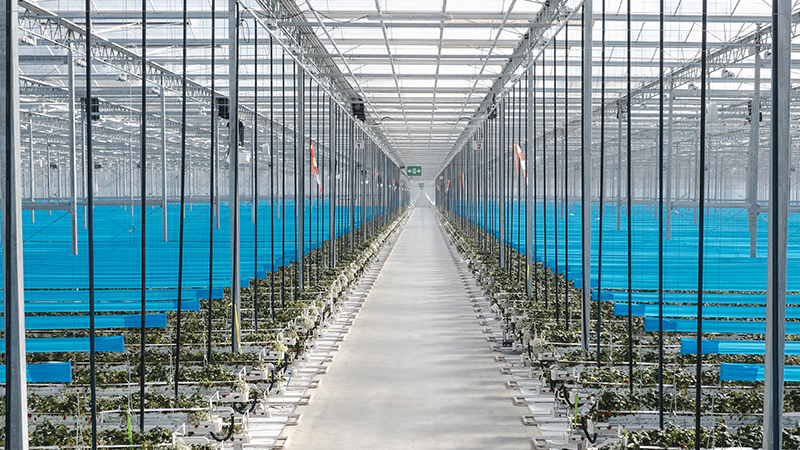
New greenhouse strawberry trials suggest growers may get more from supplemental lighting by focusing on when and how they provide it. Results from separate studies at Kwantlen Polytechnic University (KPU) in British Columbia and Biophi in Ontario were presented during the Sept. 1 Greenhouse Grower webinar, “The Impact of Light Spectrum on Greenhouse Strawberries: New Yield Data Revealed,” sponsored by Sollum Technologies. Sollum is also an industry partner in KPU’s strawberry lighting research.
The studies compared fixed or stable LED spectra with strategies that changed the spectrum during the day or at different stages of crop growth. While both found yield advantages from varying the spectrum, they also showed that results can differ considerably by strawberry cultivar and growing conditions.
One Lighting Recipe Won’t Fit Every Crop
At KPU’s Institute for Sustainable Horticulture, Postdoctoral Research Scholar Sarah Murria tested different lighting strategies across several strawberry cultivars.
Depending on the cultivar and treatment, plants grown under dynamic spectra produced yield increases of 11% to 25% compared with those under a fixed spectrum. Researchers also found that different types of light produced different plant responses.
Red light applied at certain times was associated with larger fruit and greater leaf expansion, for example, while blue light was linked to sweeter fruit, stronger red color, and earlier ripening. Far-red light encouraged longer trusses and petioles and changes in canopy structure.



But the same lighting strategy didn’t produce the same results in every cultivar. Some varieties took three to four weeks to adjust, while others responded much more quickly.
For growers, that makes results from other strawberry operations useful as a starting point rather than a ready-made recipe. The amount of natural light available, greenhouse conditions, and the cultivar being grown all influence how a crop responds to supplemental lighting.
Watch What the Plant Can Carry
A separate trial at Biophi, a horticultural innovation hub in Leamington, Ontario, reached a similar conclusion. R&D Grower Noah Weber compared Albion and Florice strawberries under stable and flexible spectrum strategies over 43 weeks of production.
Depending on the treatment combination, flexible spectrum produced 6% to 17% more yield than stable spectrum. The top-performing combination — Florice under flexible spectrum with a fixed pruning strategy — reached 22 kilograms per square meter.
The pruning results added another wrinkle. Researchers compared pruning every truss to four flowers with a more labor-intensive strategy that adjusted the number of flowers according to crop load. The fixed four-flower approach performed 11% to 14% better.
The results underscore the importance of matching fruit load to what the plant can support. Weber said excessive fruit load can lead to flower abortion, while pruning can help growers maintain fruit size and more consistent production.
That also means lighting cannot be considered on its own. Weber emphasized coordinating light with temperature, irrigation, nutrition, CO2, and humidity so that the greenhouse environment is pushing the crop in the same direction.
Rather than adopting a lighting recipe developed for another greenhouse, the studies suggest growers should use research as a baseline and then watch crop-registration data, fruit load, and plant response to determine what a particular cultivar needs under their own conditions.
You can watch the full webinar at this link on the Greenhouse Grower website.