2025 Educator/Researcher Finalist: Chieri Kubota
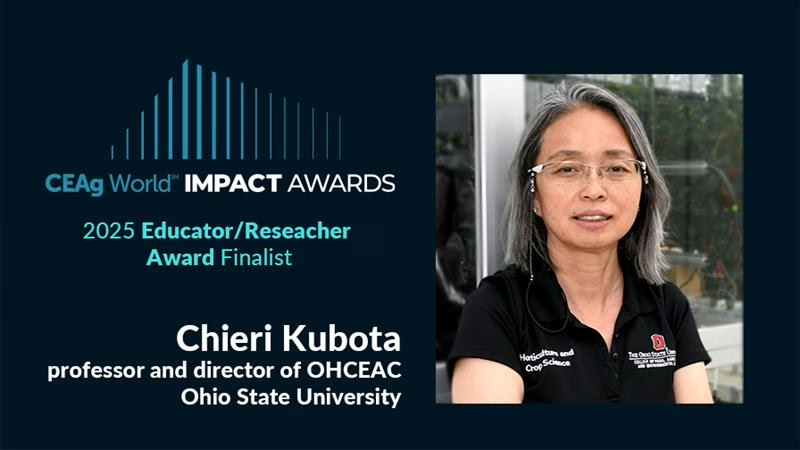
Chieri Kubota is one of three finalists in the Educator/Researcher category of the inaugural CEAg World Impact Awards.
 Chieri Kubota, Ph.D., distinguished professor of Food, Agricultural, and Environmental Sciences in the Department of Horticulture and Crop Science and director of the Ohio Controlled Environment Agriculture Center (OHCEAC) at the Ohio State University, is a finalist in the Educator/Researcher category of the inaugural CEAg World Impact Awards. The Educator/Researcher Award spotlights an individual whose outstanding contributions have advanced CEA methods through research, education, and outreach. This individual demonstrates leadership, fosters collaboration, and shares insights that enhance CEA practices, sustainability, and productivity, while exemplifying innovation, professionalism, stewardship, and a lasting impact on the CEA industry. Nominee must be employed with a college, university, or research facility.
Learn more about Dr. Kubota below, and watch CEAgWorld.com for more profiles of our finalists.
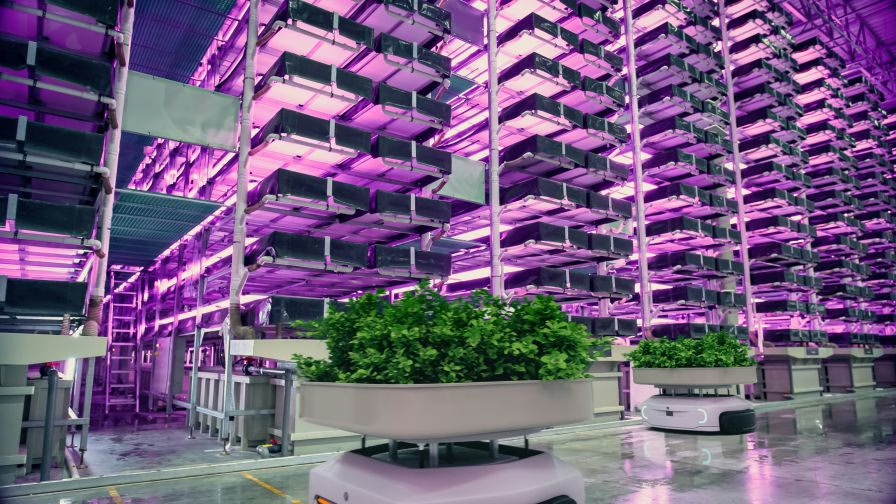
Step inside a vertical farm or a high-tech greenhouse, and you’ll witness a transformation happening throughout American agriculture: strawberries blooming in winter, tomatoes ripening without soil, custom-blended nutrient solutions perfected with the support of data-driven research. Ohio State’s Chieri Kubota has a hand in all of these, applying her rare blend of horticultural science know-how with a talent for applied problem-solving.
Dr. Kubota’s contributions to CEA ripple across boundaries: optimizing strawberry and tomato crops for greenhouse production, adapting leafy greens for vertical farms, advancing vegetable grafting physiology, and nurturing the next wave of ag-tech leaders. Her work isn’t just about growing food indoors. It’s about reshaping old models, breaking research silos, and showing how academic insight can have genuine, tangible impact for growers, students, and consumers.
Building a Unique Career Path
Dr. Kubota’s journey to this influential post didn’t follow a straight line. Originally from urban Tokyo, she grew up far from fields or farms. Her interest in biology was sparked by curiosity rather than family tradition. “I had zero understanding of agriculture or where food came from,” she says. Navigating Japan’s tough university entrance system, she landed in horticulture “almost by accident,” only to discover in lab research the thrill of manipulating plant environments for maximum growth.

Her career would soon span continents. Her internship within New Zealand’s STEM research scene, where female scientists were prominent leaders, was something she found inspiring compared to more male-dominated labs in Japan. Then, years in U.S. university labs broadened her expertise. Dr. Kubota spent 16 years at the University of Arizona, specializing in both plant physiology and technical innovation, before the chance came to build a hydroponics CEA program at the Ohio State University. Family and opportunity brought her to Columbus in 2017, a move driven by both personal connection (her husband’s roots are in Ohio) and a professional hunger to make a difference where it mattered.
From Technology Development to Crop Innovation
Dr. Kubota embraces a wide span of CEA. “I don’t focus on just one thing,” she says. “My background includes horticultural science and engineering, so I work on plant physiology, environmental responses, and technical solutions that the industry needs.”
Her projects range from improving young plant propagation to troubleshooting abnormal plant responses to controlled environments.
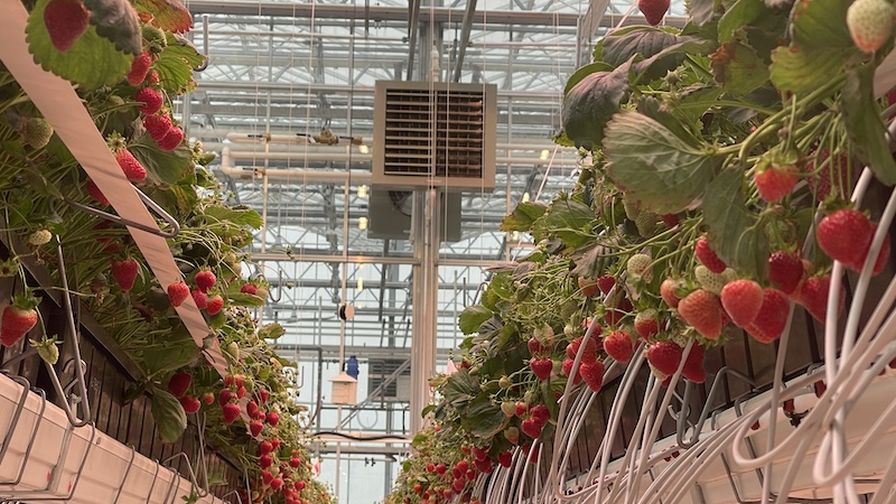
One of Dr. Kubota’s areas of interest is introducing new crops to CEA beyond tomatoes and leafy greens. Early on, she championed greenhouse strawberry production, a crop with limited existing research in indoor farming. “It was hard to get funding because nobody was doing greenhouse strawberries in the U.S.,” Kubota recalls. But through perseverance, workshops, and self-generated funds, her team’s work paved the way for a growing industry. Today, strawberries rank fourth in greenhouse crops in North America, a testament to how applied research can accelerate agricultural innovation.
Driving the Industry Forward Through Collaboration and Impact
Dr. Kubota highlights the importance of collaboration between academia, industry, and growers. Ohio State’s CEA Center (OHCEAC) organizes a research consortium with industry members to work together on precompetitive but key issues to move the industry forward. These partnerships organize conferences and workshops that keep growers updated on cutting-edge techniques, from lighting to disease management. Dr. Kubota’s current projects include propagation optimization and indoor breeding programs, where she collaborates with experts in plant breeding and food science, including flavor research.
Her teaching mirrors her research philosophy. Dr. Kubota teaches hands-on courses where students maintain hydroponic crops year-round, learning not just theory but practical skills in plant care, environmental control, and nutrient management. She notes growing student enthusiasm toward CEA careers and recently helped launch a CEA specialization within Ohio State’s Sustainable Plant Systems major, reflecting the expanding industry demand.
Expanding CEA’s Horizons
Dr. Kubota sees enormous opportunity in broadening CEA to include more food crops, especially to support low- and mid-scale producers in the U.S. While much technology today is imported from places like the Netherlands, she emphasizes the need for uniquely American innovations tailored to domestic climates and markets. “We need collaboration among suppliers, growers, and researchers,” she says, “to build technologies that fit diverse needs.”
Her ongoing projects, including vertical farm strawberry breeding, propagation improvement, and data-driven greenhouse climate control and crop management, exemplify this future-focused approach rooted in applied science. For Dr. Kubota, the goal is to make CEA accessible, sustainable, and productive for growers of all sizes, ensuring fresh food availability year-round while addressing climate and resource challenges.
The winners of the CEAg Impact Awards will be announced and honored live on stage at the kickoff ceremony for the CEAg World Conference and Expo on Nov. 20, 2025, in Durham, N.C. To learn more and join us at the conference (growers attend free), visit CEAgWorld.com/events.