2025 Visionary Grower Finalist: Bill Ferguson, Riley Creek Farms
 October 2, 2025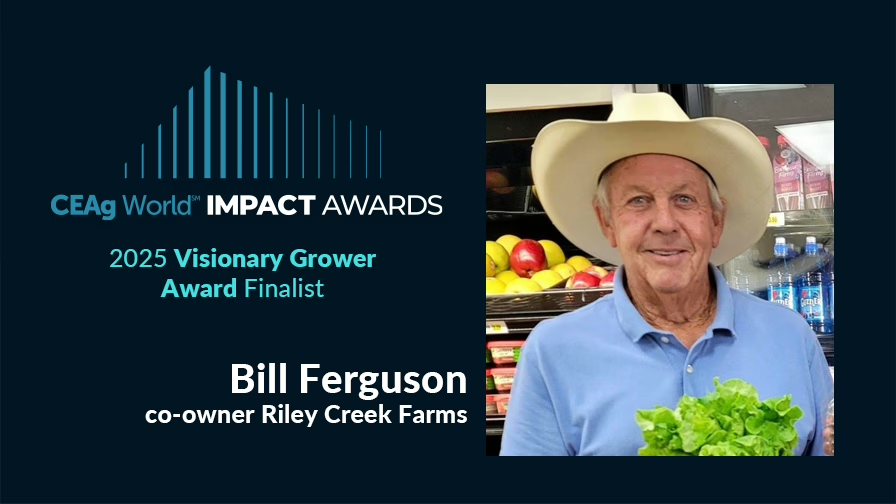
Bill Ferguson is one of three finalists in the Visionary Grower category of the inaugural CEAg World Impact Awards.
 Bill Ferguson of Riley Creek Farms in Echo, Ala., is one of three finalists in the Visionary Grower category of the inaugural CEAg World Impact Awards. The Visionary Grower Award honors an individual who has made a transformative impact on their own CEA operation, leading to remarkable gains in yield, resource efficiency, and/or profitability. The individual’s contributions to land stewardship, resource conservation, environmental preservation, and/or food security will also be considered.
Learn more about Ferguson below, and watch CEAgWorld.com for more profiles of our finalists.
As a chicken farmer for more than 20 years, 72-year-old Bill Ferguson had no plans to grow hydroponic lettuce. But when he suddenly lost his contract with poultry giant Tyson in 2023, he had no choice but to change course. “Losing that contract cost me about a million dollars,” he says. “I had to figure out what to do with four empty chicken houses that had no value.”
Over the last two years, Ferguson has devoted his efforts to transforming his Riley Creek Farms in Echo, Ala., into something many agricultural, business, and CEA experts advised him not to: An 80,000-square-foot indoor farm growing greens for local schools, grocery stores, and restaurants. Though he’s not at full capacity yet, Ferguson has put an impressive dent in his goal and hopes to inspire other poultry farmers to consider the possibilities.
While colleges and universities had their concerns about Ferguson’s project, he remained determined to give it a go. | Photo courtesy of Riley Creek Farms



Going Against the Grain
When the Tyson contract fell through, Ferguson spent two months searching for alternative uses for his chicken houses before he came across the Farm Transitions Program from Animal Outlook, a nonprofit animal advocacy organization. Aiming to save animals, help farmers, and revitalize the planet, the Farm Transition Program helps animal farmers turn their poultry and pig-farming operations into plant-growing facilities.
This is when growing hydroponic lettuce first piqued Ferguson’s interest, as he learned that the need for fresh lettuce in Echo is high— especially in schools.
“Lettuce is served two to three times per week in our school systems,” says Angela de Freitas, director of the Farm Transitions Program. “Our lettuce supply comes from Arizona and California, and there’s no way to source it locally.”
When he started exploring how to convert his chicken houses into hydroponic lettuce farms, Ferguson reached out to colleges and universities for help. Concerned that the project couldn’t be profitable (if even possible), they encouraged him to try a different approach.
“Growing hydroponic lettuce requires specific growing conditions, a lot of management, and money,” Ferguson says, “and the universities were convinced I couldn’t create the environment I needed in my chicken houses that would be cost-effective.”
But instead of deterring him, the naysayers only spurred Ferguson on. “They seemed to forget they were talking to a farmer. We don’t pay attention to what other people say, we just do it,” he says.
Investing and Offsetting Costs
Ferguson admits that his advisers were right about one thing: The project isn’t cheap. In 2023, he borrowed nearly $500,000 to renovate his first chicken house. He has continued to apply for grants since, as he needs roughly $5 million to convert all four houses and run them at capacity.
“Since this project is so unique, getting funding for him hasn’t been easy,” says Aliyah Shine, entrepreneur program specialist for HudsonAlpha Wiregrass, an ag tech organization working with Ferguson. “In my opinion, it comes from a lack of understanding and the preconceived notion that chicken houses can’t be clean.”
So far, Ferguson has converted one chicken house into a hydroponic lettuce facility that’s running at around 50% capacity, growing 2,400 heads of romaine, leaf, and butter lettuce per week in six deep water culture (DWC) systems. He’ll install five more DWC beds this fall.
“We looked at nutrient film technique (NFT) tables and measured costs, but they were just too expensive for us,” Ferguson says.
Aside from renovation expenses and the initial cost of his hydroponic systems, Ferguson notes that energy is his most significant expense. “Electricity is running me about $5,000-$6,000 a month,” he says. He reached out to different companies and organizations to help him cut down on energy costs, the bulk of which come from lighting.
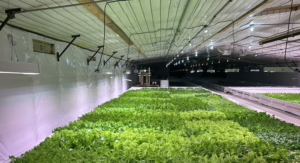
To grow hydroponic lettuce successfully, Ferguson had to learn how to manipulate the lighting spectrum. | Photo courtesy of Riley Creek Farms
The Lighting Lesson
Prior to this project, Ferguson had minimal experience growing crops with natural sunlight—think houseplants— let alone with artificial lighting. But to grow hydroponic lettuce indoors successfully while managing operating costs, he had to learn.
“One of the main mistakes we made was learning how to run the lights,” he says. “Lettuce needs a certain amount of light time, but it also needs a certain amount of dark time. And the lights we originally had were too bright, so they burned the lettuce.”
After making a few calls to CEA lighting experts, Ferguson discovered that his plants were receiving too much blue light and not enough red light. He has since installed LEDs and is on the path to finding the right spectral balance for his crops. He also invested in timers, so his lights turn on and off every 12 hours.
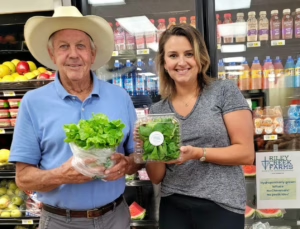
While schools are Ferguson’s top priority, he also serves five grocery stores in the area. | Photo courtesy of Riley Creek Farms
Finding the Market Demand and Meeting It
As of this writing, Ferguson’s largest contracts are with four Alabama school districts, providing fresh lettuce to more than 6,000 schoolchildren. Just one more district partnership, he says, will put him in a much better spot financially. This is largely due to USDA’s Farm to School Program, which gives schools incentive money to spend on locally grown produce.
“Each school district brings us between $1,200 to $1,500 a week,” Ferguson says. “To put this into perspective, the most I ever grossed on one chicken house was $250,000 in a year.”
Schools are Ferguson’s top priority, but he also serves five grocery stores and four restaurants in the area. The retailers, he says, have been the easiest customers to land. “We grew some lettuce, boxed it up, and took samples to local stores and restaurants,” he says. “So far, not a single person we’ve gone to has not loved it.”
By the end of 2025, Ferguson says, his first chicken house will be operating at full capacity. Then he’ll start converting the remaining three.
“If everything works out how we projected, one house will bring in more than $500,000 per year,” he says. “And once we get the other half of this first house running, we still have three more to go.”
Ferguson hopes to have all four facilities up and running within the next three to five years so he can expand his retail business and turn Riley Creek Farms into a profitable CEA operation. He also wants to show other poultry farmers that growing lettuce is a viable business.
“There are other farmers down here who are in the exact same position I was in,” he says. “They’re watching what we’re doing, and they want to do the same thing. And if they’re willing to put in some work, they’ll realize it’s a much better business than growing chickens.”
The winners of the CEAg Impact Awards will be announced and honored live on stage at the kickoff ceremony for the CEAg World Conference and Expo on Nov. 20, 2025, in Durham, N.C. To learn more and join us at the conference (growers attend free if registered by Oct. 31), visit CEAgWorld.com/events.