Reality Check: Where Does Vertical Farming Go from Here?
 May 28, 2025
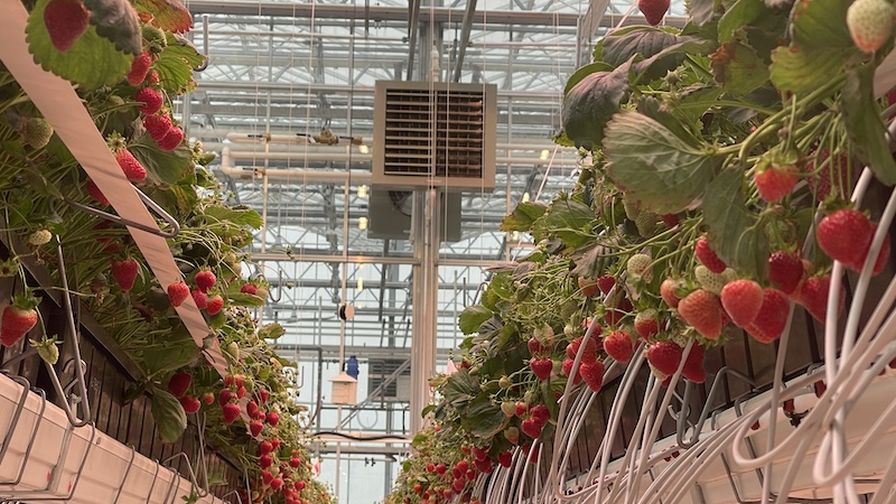
Photo courtesy of Eden Green Technology
CEAg World sat down with four key voices in the vertical farming industry for a candid discussion of the state of business in North America. The conversation offered a revealing look at lessons learned from high-profile failures, ways to minimize risk and fuel growth going forward, and opportunities worth getting excited about. You can learn more about each panelist at the bottom of this article.
Kristin Zeit, CEAg World: This industry has had a pretty rough go of it recently, with many big players shutting down or restructuring. Do vertical farming companies in North America need to rethink everything?
Andy O’Brien, GoodLeaf Farms: I visited a number of farms that are no longer in existence. From what I’ve seen, there was a lot of overengineering, a lot of money being spent without the business model validation to make it viable for investors to stick with it. What we’re all doing here is the right thing for the world, but unless it’s a viable business, it’s not going to be around.
Tom Stenzel, CEA Alliance: I agree on the overreach. The money was almost too easy for some companies. There was so much money, such a push for intellectual property. Everybody had to invent their own thing. And the investment community looked at this like a new technology as opposed to part of the food industry or produce business.
But a number of those pioneers—and I include Bowery in this—they moved the envelope so far forward. So while there are naysayers out there in our industry, I say thank you to these companies. By separating agriculture from geography, we can now get farms anywhere. We can feed people.
I’m sorry the scale didn’t work, that it couldn’t prove profitable at this point in time. But it will. It can be done, and there are companies doing it right. For new investors, it’s going to be a very different business model and different strategy for the future.
Nona Yehia, Vertical Harvest Farms: We’re going to compete with traditional agriculture. What is the opportunity for a local, urban-focused farm? For us, it’s about being hyper-local, having a curated product, and not over-indexing on technology. It’s about understanding who you are and then how you’re going to scale. We started with a small farm and made big mistakes with a little bit of money. Now we move on to a big farm. [Vertical Harvest’s Westbrook, Maine, facility is on track to open this year and is projected to grow 2 million pounds of leafy greens per year.]
Rodrigo Pereyra, former Bowery VP: The perspective I’ve come away with is, how does the technology that you have help you solve actual problems? Sometimes tech was the hammer looking for the nail—but there were also very real instances where tech allowed us to solve real problems. There’s a balance, and you can use technology in a very thoughtful way to get through challenges.
At the same time, we need to have an intense focus on the agricultural practices and think of vertical farming as agriculture-first instead of tech-first. Getting those fundamentals nailed down is incredibly important.
Stenzel: I would add that for vertical farms to compete with greenhouses now on lettuces and salads is really tough. To go to the scale that Bowery was, that’s tough to do in a commodity business.
As you look at the future of higher-value vertical crops—maybe plants grown for nutraceuticals—there’s going to be an evolution. I’m kind of seeing two tiers. There are the companies that think they’re going to be the next generation of vertical, the big scale for high value. And there are those like what Nona’s doing— that local, urban, tied-to-a-community approach. Those are pretty successful. We’re seeing some very good vertical farms, smaller scale, in cities that I think are working today.
O’Brien: I think you’re raising a very good point around a commodity business. My role [at GoodLeaf] is to help this company go from a technology company to a consumer food brand. And to have a consumer food brand, you can’t be a commodity.
You can talk about sustainability and using less water, a lower carbon footprint, and all that great stuff. But unless there’s something in it for consumers that’s meaningful—it tastes better, longer shelf life, higher nutritional value—they probably won’t open their wallets.
And when I look at what we’re doing today in vertical farming—and I mean the collective “we”—I think it’s going to be very different from what we’re doing five years from now.
We’ll use our grow rooms to produce incredible, healthier, longer lasting, locally produced leafy greens, herbs, whatever it might be. But it’s probably going to be put into other things: salad bowls, kits, smoothies, or who knows what. Do I think vertical farming can compete directly with vast grow fields and greenhouses? Not gonna happen, in my opinion.
Are there other ways vertical farming outfits can mitigate risk moving forward?
Yehia: I’m an architect by trade, and I think that that the role of design in these facilities is really important. It’s a way to future-proof the farm, by addressing questions ahead of time instead of, you know, taking things off the shelf, shoving them in, and hoping for the best.
So you look carefully at these questions beforehand: how do you design for energy adaptation? How do you design for airflow and air quality and consistency? What are the opportunities for heat exchanges? What does the logistics platform look like?
That approach has been a really good one because you have to think through every aspect of the operation and how you would design a better mouse trap for it. That’s our intellectual property, that whole ecosystem and how it works together.
Pereyra: Something I’ll keep on beating the drum on is agricultural risk and the risk of plant pathogens. It has to be at the forefront of your mind.
What are the risks with the raw materials that you bring into your farm? What is the impact of your system design on that risk, and how do you propagate risk throughout the facility? It’s capital-intensive, but how do you design the structure, how do you design the HVAC [to protect against pathogens]? These smaller things that you take for granted can have an incredible impact on your operation and on the agricultural health of the farm. It can wipe you out.
Yehia: That was one of the big mistakes we made in our little farm [in Jackson, Wyo.]. We had a plant pathogen a year and a half ago, and so we’ve spent the last year really focusing on food safety so that with the big farm in Maine—which is 20 times the size of the one in Jackson—that’s not an issue.
O’Brien: GoodLeaf has brought in some really talented players from outside the industry. Our head of operations spent 30 years at Procter & Gamble, running some of the biggest facilities for both food and non-food. We’ve brought in people from Sofina Foods, a very large meat processing facility in Canada, where they’re dealing with slaughterhouses right through to packing out product.
I do feel that GoodLeaf has a pretty strong horticulture team that knows the science behind plants and growing. But before the grow room and after the grow room, it’s pretty standardized manufacturing procedures, where you’re seeding and then you’re harvesting and packaging.
The encouragement I would give to vertical farmers is, don’t be afraid to look outside of the space to attract talent that can help you make the operations stronger and more in line with other manufacturing approaches.
Stenzel: You’ve all made great points about key internal stuff. I’ll just add that if you want to future-proof, you have to know your customer base. You also need that external perspective.
Make sure that you understand that competitive business environment. Where’s your product going to end up?
Yehia: Right. So how do you create a portfolio of products, a portfolio of customers, and be nimble across all of them and adapt to what the market needs are?
For example, in Maine, they import 95% of their food. The demand for local is across all channels, not only retail, but food service, the hospitals, schools, government, prisons. And a lot of them get subsidies for high nutrition products.
You look at your product—in this case, microgreens. Yes, it’s a premium product. But at scale, we can work something out. So when we think about, who’s our customer? We say the community is our customer. And that has enabled us to create really robust partnerships that are not just retail partnerships, but partnerships with food banks that are paying for the produce. And then we also have offtake agreements with the local food distributors.
Sometimes if you marry yourself to just one aspect of this—and we saw that happen with AppHarvest and others—if it changes and that model doesn’t work anymore, the company goes out of business.
Looking ahead, what are the opportunities and innovations in vertical farming that get you excited about the future?
O’Brien: The most exciting thing for me is the evolution of where this product can go. There’s a small company in western Canada called Inspired Go; they’re doing salad kit subscription services, shipping these $12 salads directly to homes with a seven- or eight-day shelf life. It’s growing probably a couple hundred percent every month.
That kind of combination, where you can take this business beyond competing on a commodity basis, is where it’s going to get really fun.
Pereyra: I’m starting to see some really interesting work done around the substrates. What are the substrates that will move beyond peat and coco, some of these materials that we have to import and ultimately–as we know from some of the regulations that are being passed in the EU—will eventually phase out?
Also, in terms of water treatment, you typically think of large ozone systems. We’re seeing a few things in the space developing around lower costs and effective water treatment, which is really, really interesting. That’s a challenge we have in a recirculating system; we have to treat water effectively.
Yehia: The potential around the quality of the product is amazing. I mean, I’m a microgreens fanatic. What are the opportunities to actually expand what produce means to people? It’s about taste, it’s about nutrition, it’s about how this work can have an impact at a local and global scale. And just in this little product, right? There’s a lot of opportunity there.
Stenzel: I love that. It’s a focus on the product and how we get that product to the consumer, how we make that connection.
I think there will be new products, as well. Certainly, the greenhouse sector is proving that indoor berries work. In terms of technical innovation, I’d mention breeding: all of the seed companies are breeding now for indoor, for vertical, and that’s going to make a big difference.
You don’t have to breed for drought. You don’t have to breed for pest resistance. You can breed for taste and quality.
Meet the Panelists
Tom Stenzel, Executive Director, CEA Alliance
The CEA Alliance is a membership association representing and serving indoor vertical farms and high-tech greenhouses growing produce in a highly controlled indoor environment. Stenzel is the group’s executive director; he previously served as president and CEO of the United Fresh Produce Association for 29 years, then helped launch the International Fresh Produce Association (IFPA). He served as co-CEO of IFPA through March 2022 before forming his own consulting business, The Stenzel Group LLC.
Nona Yehia, Co-founder and CEO, Vertical Harvest Farms
Vertical Harvest Farms is an urban hydroponic grower with a mission to provide meaningful careers for people who have been historically underserved. Its Jackson, Wyo., farm will be joined by a second facility in Maine in 2025. Yehia co-founded the company in 2016 and has been named a CNN Champion of Change as well as a Tony Hsieh Award Fellow, exploring the future of human capital in business. As a member of the World Economic Forum’s Global Future Council on Cities, she contributes to shaping urban environments that are equitable, sustainable, and resilient.
Andy O’Brien, President and CEO, GoodLeaf Farms
GoodLeaf Farms is Canada’s first and largest commercial indoor vertical farm operator, producing up to 10 million kilograms of produce per year, distributed across the country. O’Brien joined GoodLeaf in July 2024 with 30 years of experience in the food industry, specializing in C-suite leadership and board roles. He served as CEO of M&M Food Market, ran multiple Canadian restaurant chains, and held leadership positions for such consumer packaged goods brands as General Mills, Campbell’s, and Mars.
Rodrigo Pereyra, Former VP of AgScience, Bowery Farming
Bowery Farming had been the largest vertical farming operation in the U.S. until it ceased operations in November 2024. Pereyra was Bowery’s vice president of Agricultural Science, leading agricultural R&D and R&D operations and pushing the boundaries of yield and quality in indoor farms. Prior to Bowery, Rodrigo was vice president of product for GroiQ, a sensor and data platform for cannabis cultivators, and had a 15-year career at OSRAM Sylvania where he developed novel lighting technologies including horticultural lighting systems.