Research Brief: Better Strawberry Propagation Indoors
 February 3, 2026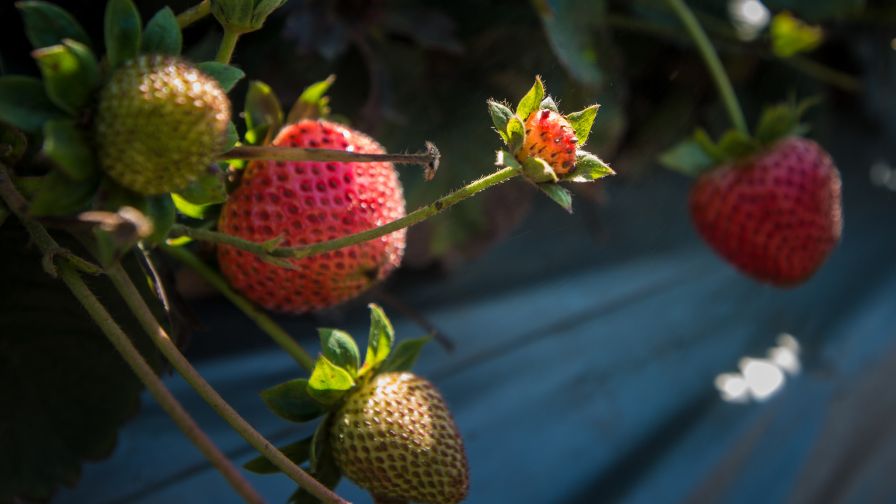
Strawberries growing indoors. | Photo courtesy of Adobe Stock
Moein Moosavi-Nezhad, a Ph.D. student studying CEA at North Carolina State University, was recognized by the American Society for Horticultural Science for his work with CEA strawberries in June 2025. His work centers on a critical problem for strawberry growers: obtaining clean strawberry plants and growing them in large quantities.
“The U.S. strawberry industry has a challenge of providing growers with clean, disease-free planting material,” he says. “CEA offers an alternative solution for open-field systems, as growers can grow high-quality daughter plants at higher yields.”
When a “mother” strawberry plant goes into the ground, it produces runners that then produce daughter plants. Since runners grow horizontally in fields, they touch the soil, where they can pick up infections.
“Disease is a big problem,” he says. “Based on that and the low yield of plant propagation in open-field nurseries, we wanted to try growing these plants vertically.”
The standard for greenhouse growers is nine strawberry plants per square meter. But by using an indoor vertical system, Moosavi-Nezhad increased the planting density to 19 plants per square meter. As a result, he was able to optimize his lighting conditions to propagate between 1,200-1,300 daughter plants: a sizeable increase from the 300 propagated in most greenhouse systems.




“In my experiment, we optimized top versus intercanopy lighting distribution,” Moosavi-Nezhad explains. Instead of sourcing light solely from fixtures above the strawberry plants, he also used fixtures around the middle and lower parts of the plants to increase light delivery. As a result, he was able to create better growing conditions for strawberry plants and increase yield.
Moosavi-Nezhad believes that growers will have more consistent access to quality plant material and achieve higher yields via this method. But he says that more research needs to be done on the sustainability of these systems.
“Right now, I can promise growers clean daughter plants and increased yield,” he says. “But I can’t promise that open-field growers will achieve better profitability when they invest in our system.”
Editor’s note: This article was originally published in our 2025 Industry Report: State of the CEA Industry.