Research Brief: One Step Closer to Robot Swarms
 January 13, 2026
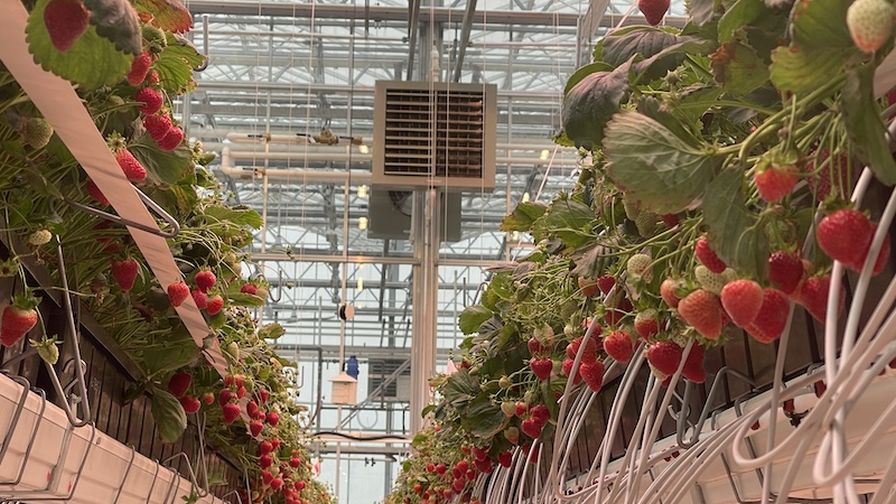
Industrial greenhouse with rows of cultivation. | Photo courtesy of Adobe Stock
In January 2025, it was announced that researchers at the Massachusetts Institute of Technology (MIT) have made significant progress on robotic insects to make artificial pollination more efficient. According to a report from MIT News, the goal of the project is to boost yields for greenhouse growers and indoor farmers. The research was published in the journal Science Robotics.
Up until now, even the smallest, quickest artificial pollinators haven’t been able to match the efficiency of bees. In light of this, MIT researchers set out to create aerial robots that are more agile, maneuverable, and better match the abilities of natural pollinators.
Past versions of the robotic insects were much larger than bees (about the size of a microcassette tape) and had eight mechanical wings, which prevented them from staying in flight for long periods of time. The new design is about half that size and has only four wings, helping stabilize the bots and allowing them to carry extra weight.
In addition, the researchers created stronger transmissions that connect the robots’ mechanical wings to the artificial muscles (which are composed of elastomer and thin carbon nanotube electrodes) that make them flap. This makes it easier for the robots to fly and improves their endurance.
The researchers’ robots are now lighter than a paper clip, which improves their agility and reduces the strain put on their mechanical wings. They can also stay airborne for about 1,000 seconds (17 minutes)–100 seconds longer than the researchers’ previous designs–and fly at an average speed of 35 centimeters per second.




Moving forward, the researchers are working to increase the robots’ flight time to more than 10,000 seconds. But first, they’re focusing on installing batteries and sensors to make these robotic insects viable for large-scale growing operations.
Editor’s note: This article was originally published in our 2025 Industry Report: State of the CEA Industry.