Top Mistakes Substrate Growers Make, and How to Avoid Them

 November 5, 2025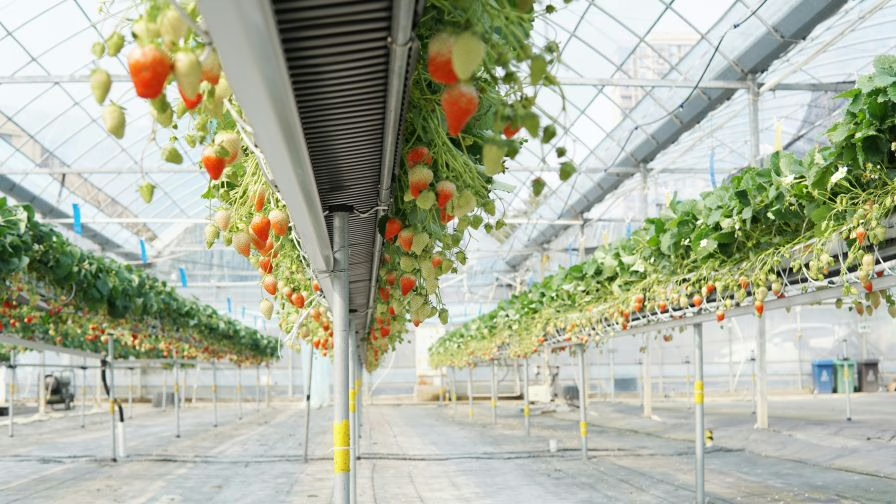
Strawberries growing in a greenhouse. | Photo courtesy of Israel Holby
Around the world, more growers are turning to substrate systems as they look for ways to increase yields, reduce disease pressure, and make production more predictable. Substrate production offers something invaluable: the ability to manage the rootzone with consistency. That level of control makes it possible to scale crops in ways that soil or open-field systems often cannot.
Yet precision is both the advantage and the challenge. In commercial substrate, there is little buffer. Every decision — irrigation timing, substrate blend, container type, fertigation strategy, etc. — directly shapes plant performance. When those pieces align, the results can be exceptional. When they don’t, problems can escalate quickly.
Our experiences, from test farms to research trials to thousands of grower visits worldwide, have revealed the same themes. Whether in high-tech greenhouses or open-field tabletop systems, growers run into a similar set of pitfalls. The good news is that these mistakes are avoidable. By looking at the root causes and the practical fixes, what separates frustration from profitability in substrate production becomes pretty clear.
Mistake 1: Blind Spots in Monitoring
One of the most common problems we see in substrate production isn’t a broken system — it’s a broken habit. Too often, monitoring is inconsistent. A meter goes uncalibrated, weekend checks get skipped, or data gets recorded but isn’t reviewed until the next day. In the meantime, the crop is left to steer itself.
The difficulty is that the rootzone doesn’t give up its secrets easily. Stress accumulates below the surface long before it appears in the canopy. By the time leaves wilt, chlorosis sets in, or blossom-end rot appears, yield potential has already been lost.




That’s why monitoring needs to be disciplined. Simple metrics — electrical conductivity (EC) and pH in the drip and drain, drainage percentage, and substrate moisture — are the key. Rising EC might not look urgent from day to day, but it signals salts accumulating in the rootzone. A drifting pH can quietly lock up calcium or iron long before deficiency symptoms appear.
The numbers alone aren’t enough. They must be paired with trained eyes on the crop. A scout who catches early spider mite speckling, a broken dripper, or fruit beginning to rot is providing context the data can’t. When consistent data collection and consistent scouting work together, growers move from reacting to problems to steering the crop — protecting yield before stress ever reaches the canopy.
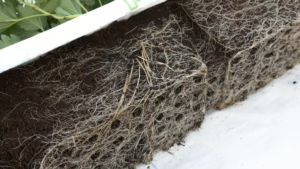
A uniform, well-drained rootzone is the foundation of every successful system. Precision in monitoring, irrigation, and design turns consistency into profitability. | Photo courtesy of Israel Holby
Mistake 2: Managing One Variable Instead of the System
It’s tempting to look for a single culprit when problems arise in a crop: “the substrate doesn’t drain well” or “the irrigation cycles are too short.” But in reality, no input operates in isolation. Substrate performance is shaped just as much by container geometry, irrigation frequency, fertigation strategy, and even cultivar vigor.
A coconut coir blend, for example, behaves one way in a tall container, where gravity helps drainage and the perched water table is proportionally small. Put the same coir in a shallow container, and suddenly the perched water table dominates the rootzone, oxygen availability drops, and plants show stress. Without changing the irrigation regime, this can lead to plants losing moisture and yield. What looks like a substrate issue is often the interaction between the substrate, the container, and the irrigation schedule.
This is where system thinking matters. The principle is captured well by Liebig’s Law: Growth is not limited by the total resources available, but by the weakest link. And in substrate systems, that weak link is often not a single factor, but the way two or three factors interact.
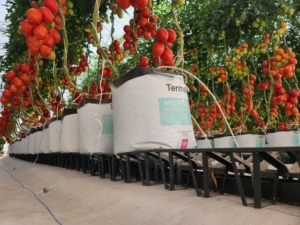
Consistent substrate elevation improves drainage, aeration, and root health – critical for uniform fruiting and sustained yield in high-yield tomato production. | Photo courtesy of Israel Holby
Mistake 3: Static Management in a Dynamic System
Substrate systems reward precision, but precision can become a trap when management is too rigid. Many operations still rely on fixed irrigation schedules or recipes borrowed from last season. It’s a comfortable habit — but plants don’t live in averages, and they don’t respond to last year’s weather.
Conditions shift daily and even hourly. Light intensity, humidity, and temperature can change the plant’s demand in ways a static plan simply can’t match. We’ve seen sections of greenhouses where microclimates create dramatically different rootzone conditions. In one case, a shaded block held too much moisture, oxygen levels dropped, and nutrient imbalances began to surface. The system itself wasn’t flawed — the mistake was treating yesterday’s irrigation strategy as if it applied everywhere, every day.
Averages can be especially misleading. On one of our farms, the daily drainage ratio looked perfect on paper. But when broken down by time of day, the picture changed: over-irrigation in the morning, water stress at midday, and no dry-down overnight. The canopy looked fine at first glance, but the roots told a different story.
Pairing light data with drainage records, adjusting irrigation to match shifts in demand, and recognizing microclimates within the same structure can transform results.
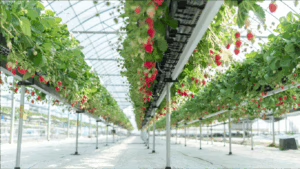
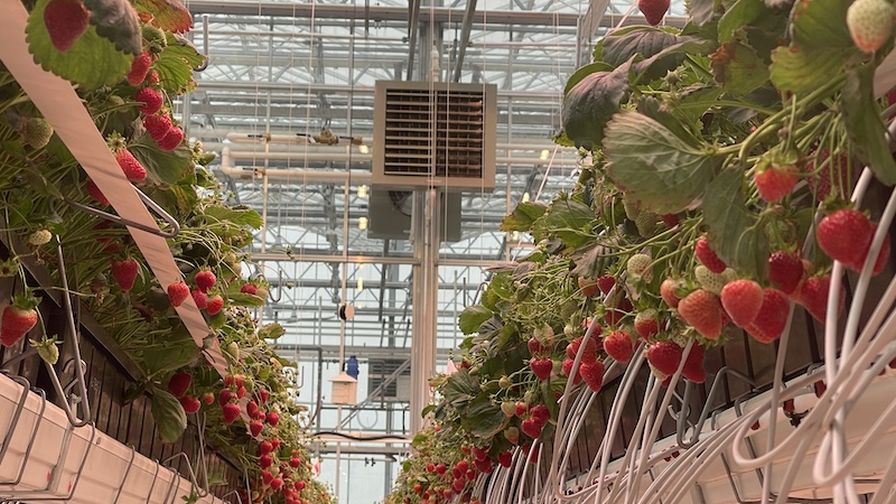
Hanging gutter systems enhance airflow, drainage, and fruit quality in high-density strawberry production by reducing humidity and disease pressure. | Photo courtesy of Israel Holby
Mistake 4: Complexity Dilutes Control
When a system isn’t performing the way we want, the instinct is often to add more: more substrates, more container types, more cultivars, more irrigation strategies. It may look like a path to innovation, but in practice, it often creates confusion. The more moving parts we layer into a production system, the harder it becomes to isolate what’s working — and what isn’t. We see this in research trials as well. A design that stacks three substrates, two container types, three irrigation methods, and three cultivars doesn’t look overwhelming in theory. But in reality, that’s 54 different treatments — more than most growers, or even researchers, can reasonably interpret. With so many variables interacting, it’s nearly impossible to pinpoint what’s driving the results.
The same holds true in commercial production. Mixing too many substrates or cultivars under one fertigation regime dilutes uniformity and undermines scale. Complexity looks impressive, but it reduces repeatability — and without repeatability, profitability is difficult to achieve. The solution is to simplify. In production, that means standardizing substrates, irrigation strategies, and even crop choices. Some of the most successful growers we’ve seen focus on just one or two crops, with each type produced in its own dedicated zone. That focus allows every decision — from fertigation recipe to climate control — to be tailored precisely to the physiology of the plant.
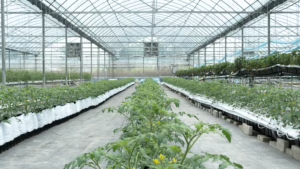
Elevated and hanging substrate systems enable efficient use of greenhouse space, supporting multi-crop production with improved drainage and climate control. | Photo courtesy of Israel Holby
From Mistakes to Mastery
Across hundreds of farms and countless trials, these four mistakes appear again and again: monitoring blind spots, treating variables in isolation, relying on static plans in dynamic conditions, and layering on complexity until control is lost. Each looks different in the moment, but they all point back to the same principle:
Uniformity + Control = Scalability = Profitability.
Uniformity gives us confidence in our measurements. Control allows growers to steer crops instead of reacting to them. Together, they create repeatability that makes it possible to expand acreage, replicate results across zones, and scale an operation profitably.
Substrate systems are expanding because they give growers the tools to manage with precision. But tools only create value when used well. The growers who succeed are the ones who treat mistakes as signals, not setbacks — adjusting their management until clarity, consistency, and profitability align.
The future of substrate growing won’t be defined by who has the most technology, but by who uses it most effectively. Precision without discipline is just noise, but precision with focus becomes profit. Growers who commit to control, uniformity, and simplicity will not only avoid costly mistakes — they will set the standard for how substrate systems are scaled around the world.