Expert Roundtable: The Fundamental Advantages of Greenhouse Production
 August 29, 2025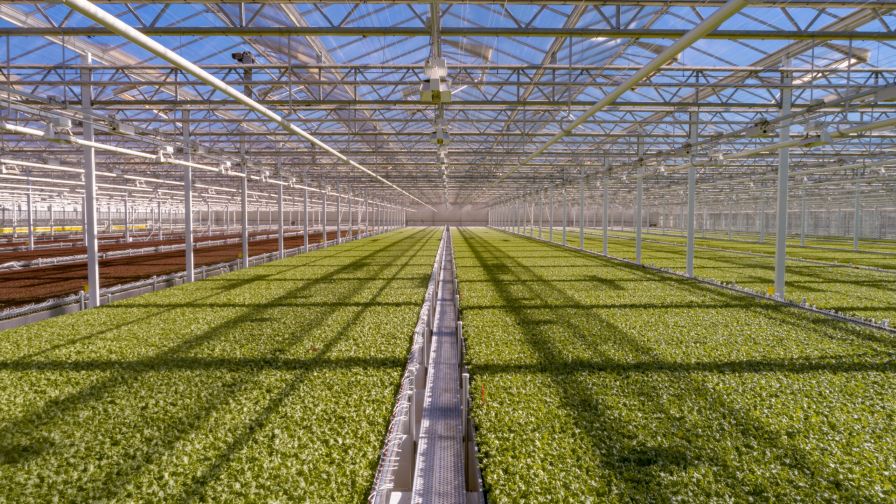
Photo courtesy of Little Leaf Farms
As the CEA industry has evolved, embracing vertical farms and an influx of tech innovations, greenhouse businesses have evolved, as well—but key challenges (and possibilities) remain. We spoke with three high-level greenhouse professionals about the sector’s unique promise and pathways to success.
Kristin D. Zeit, CEAg World: At the time of this conversation, U.S. policy changes are keeping North American growers on their toes as we wait to see the impact of tariffs, immigration measures, and funding cuts. How is this playing out in your worlds?
Vonnie Estes, International Fresh Produce Association: We’re seeing the weight of policy hit greenhouse producers from multiple sides—especially on tariffs and immigration.
On the trade front, U.S. tariffs on Canadian greenhouse produce have disrupted decades of cross- border supply chain integration. Canadian growers are losing millions per day during enforcement surges, while American buyers face higher prices and less supply. U.S. growers importing critical crop inputs—like climate-control equipment, fertilizers, and plastic film—are also being hit by rising import duties. That’s a double blow.
Maria Deschauer, Vermillion Growers: We’re just in our second season of growing tomatoes in Manitoba. And from a Canadian perspective, I think everyone is a little bit nervous in terms of where our product is going to go, and what’s going to happen to the price. The price that we’re getting is essential for financial stability and sustainable operations.
So there seems to be a little bit of pause, as everyone’s waiting to see the effect of potential tariffs.


Paul Sellew, Little Leaf Farms: Anyone in the greenhouse industry who’s building a high-tech greenhouse is dependent on the European supply chain. So all of the tariff discussion and the uncertainty and risk that it’s put into the market—it’s certainly not helpful.
And, you know, there’s a policy one day, and then it can change on a moment’s notice. So I think this has also impacted the capital markets, and that’s going to make for a more conservative financing environment.
Estes: The labor picture is just as complex. Greenhouse agriculture depends heavily on immigrant labor, and reforms to programs like H-2A have lagged behind the reality on the ground. Delays in approvals, cost increases, and political uncertainty are making it harder for growers to plan labor-intensive planting and harvesting cycles. We need an immigration system that recognizes the skilled, seasonal nature of this work.
CEAg World: Beyond these policy issues, what else stands out as key challenges for greenhouse growers today?
Deschauer: There’s just a huge barrier in terms of the capital required to get into this industry. I’m very young at this still, and we’re still learning a lot. Setting up the systems is challenging and so is labor, finding the right people for the right seats. But we’re well on our way.
As you know, the tomato crop is very labor-intensive. We’ve been able to incorporate a little bit of automation with our packing line and we’re keeping a keen eye on different robotic options for the future. We’d love to incorporate as much as we can, but we’re staying pretty conservative at the moment.
Estes: Capital intensity is definitely a barrier—whether you’re retrofitting older infrastructure or building from the ground up, the dollars required can be staggering. While AI, automation, and data systems offer promising efficiency gains, I’ve seen too many operations invest ahead of revenue. This disconnect between tech promise and ag practicality still trips up even the most well-intentioned businesses.
Today’s biggest hurdles also include volatile energy costs, a persistent labor crunch, and the pressure to deliver high- quality, sustainable food with shrinking margins. Plus fragility in the supply chain. In this landscape, growers are being asked to act like startups and manufacturers at the same time, which is no easy feat.
Sellew: I’ve spent my life in the greenhouse industry, and I think the same challenges have always been there and always will be. You have to master at least three core things: One, you have to be a great grower. You have to do all the things necessary to support the business from a yield and quality standpoint.
Two, you need to be a great operator. You’re responsible for packaging lines, logistics, transportation. And then you need to be really great at marketing and sales.
It’s not an uncomplicated business—you have all the farming risk, and then you combine that with operations, logistics, sales, and marketing. You need to bring together a team of people who know their domains, with everybody pulling in the same direction to make it into a successful company.
CEAg World: The CEA investment picture has changed dramatically in the last decade. How would you characterize the effect on greenhouse businesses, and what’s the best way forward?
Estes: There’s no denying it: CEA is in a correction. Vertical farming attracted massive capital in 2021 and 2022, but many players scaled prematurely, investing in sophisticated tech without validating the business fundamentals.
Greenhouses, however, have fared slightly better, thanks to more established business models and better unit economics. One of the advantages I see from all of the investment in vertical farms is the ramp-up and spillover of technology into the traditional greenhouse industry. Investors in the space are now leaning into disciplined innovation: They want capital-efficient operators with steady cash flow and a real customer base.
This means greenhouses need to sharpen their value proposition—optimize for energy, standardize operations, and diversify into channels like foodservice or direct-to-consumer, where freshness and quality command premiums.
Sellew: Before it was CEA, it was the greenhouse industry. It’s been around for a long time, it’s here now, and it’ll be here in the future. After going through this investment bubble of historic proportions, the “new normal” is the business climate I’ve operated in for the vast majority of my career. Unit economics count. A business needs to make a profit.
CEAg World: Where do you see the biggest opportunities right now?
Deschauer: I think a lot of growth is going to happen in North America, especially after talking to some of our friends in Europe and building companies from the Netherlands. They’re really trying to engage new business in North America.
For our company, it’s really an opportunity of location. We’re the only facility of its kind in Central Canada, so we’re closer to market. We’re looking at the opportunity that brings for potential expansion, moving from just tomatoes into other vine crops, but also ensuring that as we expand, we can respond to the market needs. Right now, in Canada, a lot of the large retail chains almost have a “buy local” mandate.
Estes: It’s a bright spot. In Canada, national attention is shifting toward food sovereignty. Investments in CEA—particularly vertical and greenhouse farms—are being championed not just for innovation, but as infrastructure critical to food security.
I’m excited by the convergence of consumer demand and technology. People want food that’s local, traceable, and sustainably grown; CEA is perfectly positioned to deliver on that.
Innovation in automation, LED lighting, and environmental controls has radically improved our ability to produce more with less—less water, less land, fewer inputs. We’re also starting to see smart operators lean into higher-value SKUs like herbs, microgreens, and strawberries, where premium pricing and shorter cycles make economic sense.
Greenhouses are evolving into precision facilities, not unlike pharmaceutical clean rooms. With the right focus on operational excellence and market fit—not just tech flash—we can unlock scale, profitability, and resilience. The survivors of this CEA recalibration will be the ones who get lean, stay pragmatic, and deliver real value to consumers and retailers alike.
The best path forward? Stay focused. Don’t overbuild or overengineer. Understand your regional advantages— whether it’s climate, energy pricing, or labor pools—and build around them.
Meet the Panelists
Vonnie Estes, Vice President of Innovation, International Fresh Produce Association (IFPA)
Estes’ role is to bring technology to the produce industry across the supply chain, working with both technology companies and the industry to identify and solve pressing needs. Her career work has consistently focused on bringing innovative genetics and crop inputs to market, for crops grown indoors and outdoors, and developing go-to-market strategies that navigate complex supply chains. Estes led IFPA’s CEA Council for two years, aiming to support and integrate the industry into retail markets. Beyond her work at IFPA, she serves as an adviser to the CEA Alliance and sits on the board of the Resource Innovation Institute.
Paul Sellew, Founder and CEO, Little Leaf Farms
Little Leaf Farms is the United States’ largest greenhouse producer of hydroponic baby greens. The greens are grown and packaged at its Devens, Mass., and McAdoo, Pa., greenhouses and sold in over 7,000 grocery stores and fine dining establishments across the Eastern half of the U.S. Sellew is a graduate of Cornell University College of Agriculture and Life Sciences and has sat on the board of directors for the U.S. Composting Council. He grew up in and around horticulture and has more than 30 years of experience in developing and leading successful companies, including Backyard Farms and Harvest Power. He founded Little Leaf Farms in 2015.
Maria Deschauer, Co-founder and Managing Director, Vermillion Growers
Vermillion Growers opened in 2023 as the first large-scale vegetable greenhouse in Manitoba, Canada. The 10-acre, high-tech facility specializes in tomatoes on the vine. Deschauer is a seasoned entrepreneur with a passion for economic growth and job creation in rural Manitoba. Before joining the CEA industry, she had a highly successful career in property development/management.
Editor’s note: The roundtable interview was edited for clarity and space, and was originally published in our Industry Report: Greenhouse Produce.