Why Commercial Growers Are Running Their Greenhouses Digitally First
 August 4, 2026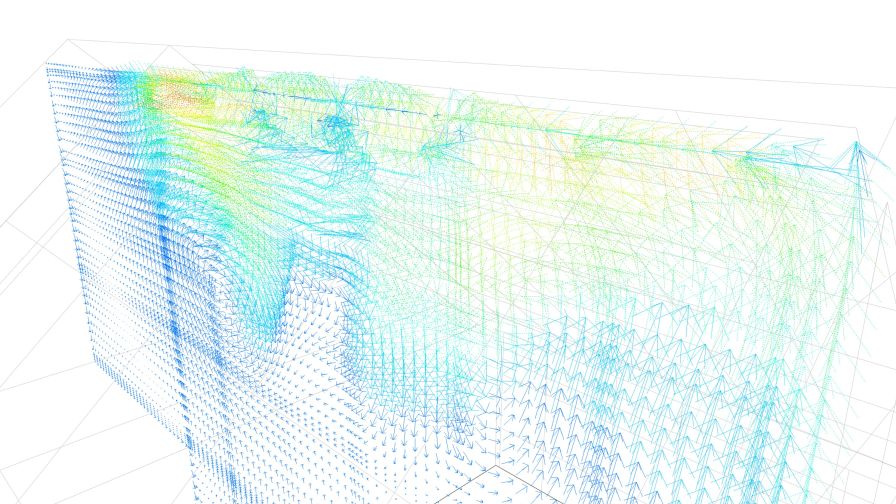
Airflow analysis to inform ventilation strategy. | Ceres Greenhouse Solutions
For most of greenhouse growing’s history, there was only one way to find out how a new facility would really perform: build it and see.
Load calculations gave you a reasonable foundation. Experienced engineers and contractors reduced the risk. But the full picture, how heat, humidity, airflow, and mechanical systems would interact under real seasonal conditions, only revealed itself once the greenhouse was operational.
That approach made sense when the cost of being wrong was manageable. It’s harder to justify today.
Construction costs have climbed, as well as interest rates. Energy expenses are volatile. Margins in commercial production leave little room for facilities that underperform across their first few seasons. A greenhouse that runs hotter than expected in July, or struggles with humidity control every winter, or demands more from its HVAC than anyone planned for, isn’t just an operational inconvenience; it’s a negative financial impact that compounds year after year on top of an already costly capital expense.
The growers finding a way around this problem aren’t waiting until after construction to understand how their greenhouse performs. They’re running it first digitally, against real climate data, across a full simulated year before the first structural component is installed. And what those simulations are revealing is changing how some of the industry’s most forward-thinking operations approach design from the ground up.



Why Greenhouses Are Uniquely Hard to Design
The reason standard design approaches leave these performance gaps isn’t negligence; it’s the nature of the tools.
Traditional load calculations are built to answer one question well: what’s the peak demand on the worst day of the year? Size the equipment to meet that moment, and everything else follows. It’s a reasonable framework for conventional buildings. For greenhouses, it misses too much.
Greenhouses are environments where every system is continuously influencing every other system. Solar gain affects cooling demand. Ventilation affects humidity. Glazing affects plant temperature. Shade systems alter both light levels and thermal loads. HVAC operation affects airflow and condensation. A design decision that looks sound when each system is evaluated in isolation can behave very differently when all of them are running simultaneously — under real weather, across a full season, with a living crop in the house.
Peak-load calculations don’t model that interaction. They capture a moment. What growers actually need to understand is how their facility performs across thousands of moments. That’s not a calculation. That’s a simulation. And the difference between the two is where a growing number of commercial growers are finding the answers that change how they build.
What Does it Mean to Run a Greenhouse “Digitally”?
At its core, building performance simulation takes the physical characteristics of a greenhouse and models how all of those elements behave together under real climate conditions. Not a single peak day. A full year, hour by hour, using actual weather data from the project’s relative location.
The output isn’t a drawing or a specification. It’s answers to the operational questions that matter most before a design is finalized:
- How hot will the greenhouse get on a peak July afternoon with full solar load and a crop in the house?
- Will the natural ventilation strategy move enough air during the hottest weeks of the season?
- What does humidity look like on a cold January night when outdoor temps drop, and the crop is actively transpiring?
- How much will the heating system actually demand during a low-temperature day?
- Can my SOPs (standard operating procedures) be modeled so that they are optimized to lower my energy costs? And then can these SOP models be transferred to my controller during the build?
The difference between knowing those answers before construction and learning them after is, increasingly, the difference between a facility that performs and one that costs.
What Simulation Reveals That Calculations Miss: Real Design Scenarios
The best way to understand what simulation reveals is to look at the specific design questions it answers. The following are common scenarios that are helpful to simulate before breaking ground.
Will Natural Ventilation Actually Work in This Climate?
Natural ventilation is an attractive strategy for a reason. When it works, it reduces mechanical cooling loads, lowers energy costs, and creates a more passive, resilient operating environment.
A ventilation strategy that looks adequate on paper may fall short during the specific combination of high outdoor temperatures and low wind speed that occurs repeatedly throughout a summer season.
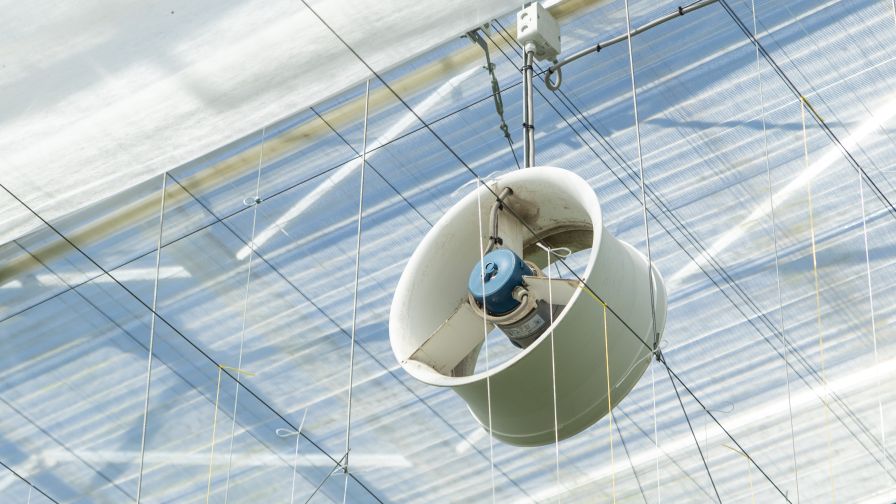
Simulation models roof vent performance, sidewall airflow, exhaust fan effectiveness, and intake air paths against real hourly weather data. It reveals not just whether a natural ventilation strategy works in theory, but whether it works on the thirty hottest days of the year in that specific location, and what the backup strategy needs to be when it doesn’t.
For growers in climates where natural ventilation is viable most of the season, that distinction can mean the difference between a well-calibrated hybrid system and a mechanical cooling system that’s perpetually compensating for a ventilation strategy that was never quite enough.
What Will Humidity Look Like in Winter?
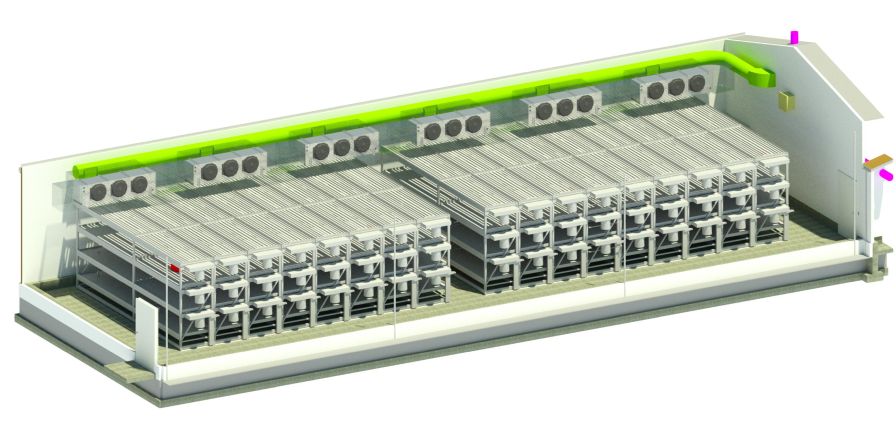
HVAC simulation for demand sizing. | Ceres Greenhouse Solutions
Humidity is one of the most underestimated design challenges in commercial greenhouse production. It’s also one of the most expensive to get wrong.
During cold months, the conditions for moisture accumulation are almost always present. Outdoor temperatures drop. You open up your greenhouse less to conserve heat. Crops continue transpiring. Moisture builds inside the greenhouse faster than passive strategies can manage it, and if the dehumidification system wasn’t sized for those conditions, or wasn’t included in the original design at all, the grower finds out the hard way.
Elevated humidity increases disease pressure, affects crop quality, and creates conditions that are difficult and costly to correct once a season is underway.
Simulation models latent loads and moisture accumulation across the full year, including the shoulder seasons where humidity behavior is hardest to predict and most often overlooked. It helps size dehumidification systems before they become a retrofit and identifies the ventilation and heating strategies that keep moisture in check without sacrificing energy efficiency.
What Will the HVAC System Actually Demand? And Is It Sized Correctly?
Equipment sizing is one of the areas where the gap between calculation and simulation shows up most clearly.
A system sized to peak load calculations may be technically correct for the worst day of the year while being subtly wrong for how the facility operates the rest of the time. Oversized equipment short-cycles (turns off and on too frequently without running through a normal cooling or heating cycle), reducing efficiency and making humidity control arder to maintain during moderate conditions. Undersized equipment runs continuously under peak load, wears faster, and fails to hold set points when the greenhouse needs it most.
Simulation evaluates how heating and cooling systems respond to changing conditions across every season, not just peak days. The result is a clearer, more accurate picture of what the mechanical system actually needs to do, and a better foundation for sizing decisions that affect operating costs for the life of the facility.
For growers investing in heat pumps, energy recovery systems, or other mechanical heating and cooling equipment, this level of modeling becomes even more critical. These systems perform very differently across a range of operating conditions, and simulation is often the only way to evaluate that performance honestly before equipment is specified and purchased.
How Will the Facility Perform in This Specific Climate?
This question matters more than it’s often given credit for, especially for growers expanding to new regions or building their first facility outside of a familiar climate zone.
The design assumptions that work well in the Pacific Northwest don’t translate directly to Nevada, Florida, or the Upper Midwest.
Simulation uses detailed hourly weather data specific to a project’s geographic area to evaluate how a proposed design will actually perform in that climate. It exposes the regional variables that generic design approaches tend to smooth over like: the afternoon humidity spikes that drive latent cooling loads in the Southeast, the extended heating seasons that dominate operating costs in northern climates, and the high solar exposure that makes shade management a year-round consideration in the desert Southwest.
For growers making site selection decisions, this kind of climate-specific modeling can also inform where to build. Not just how.
This piece was originally featured on our sister site, Greenhouse Grower. For more information on designing greenhouse digitally, including the results of Ceres Greenhouse Solutions’ digital lighting case study, click here to read the original article.