
Spectrum Control vs. LEDs: Rethinking Greenhouse Lighting Economics
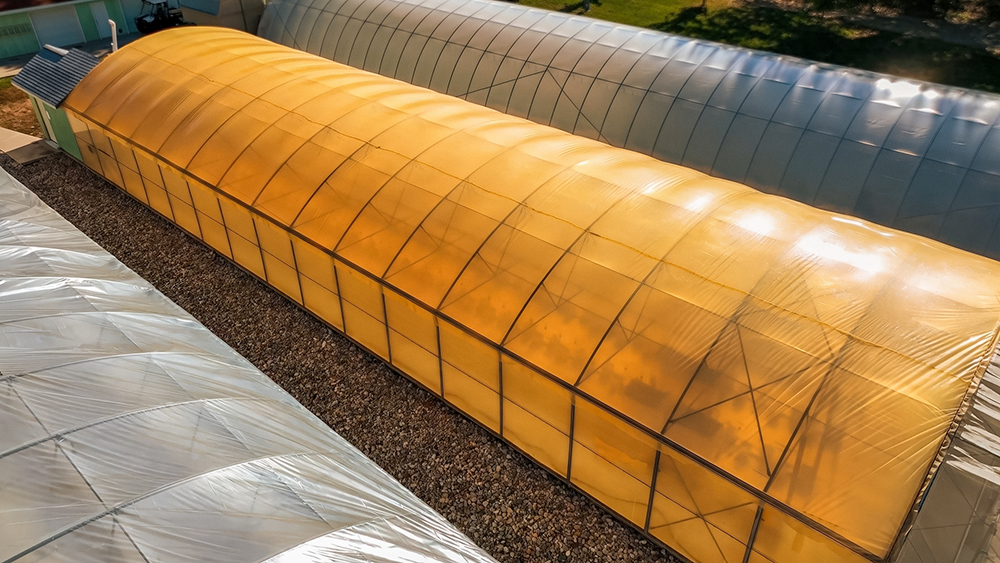
Aerial view of a commercial hoop house covered in glowing orange UbiGro film alongside standard poly houses.
When the Daily Light Integral (DLI) drops during darker seasons, commercial operations seek ways to protect crop cycles and maintain yields. The common response is to add high-intensity LED fixtures, but supplemental lighting entails high upfront capital costs and recurring electricity expenses. At roughly $75 per square foot, outfitting a facility can increase initial capital lighting costs by 3 to 4 times those of legacy fixtures.
Canopy Bottlenecks Under LEDs
Hanging point-source fixtures change how photons move through the crop.
- Directional Shading: Diodes emit light in straight lines with no atmospheric scatter. The top canopy can block incoming light, casting heavy shadows that starve mid- and lower-level foliage of usable Photosynthetically Active Radiation (PAR).
- Photobleaching and Leaf Burn: Concentrated light points directly over the canopy can deliver photons faster than plant tissue can process energy. This can cause localized heat stress, leaf burn, and photobleaching, degrading chlorophyll and stunting growth.
- Fixed Spectrum Output: Narrow diode bands fail to match the dynamic, broad-spectrum balance that plants evolved to utilize under natural sunlight.
Optimizing Natural Sunlight with Quantum Dots
Sunlight provides the ideal full spectrum for plant growth, but solar radiation naturally contains an excess of short-wavelength UV and blue photons relative to crop demand. Photosynthetic conversion efficiency peaks in the orange and red regions of the spectrum (600 to 650 nm), where chlorophyll absorbs photons most effectively.
UbiGro embeds quantum dot nanotechnology into greenhouse covering film to modify incoming sunlight without drawing electricity.
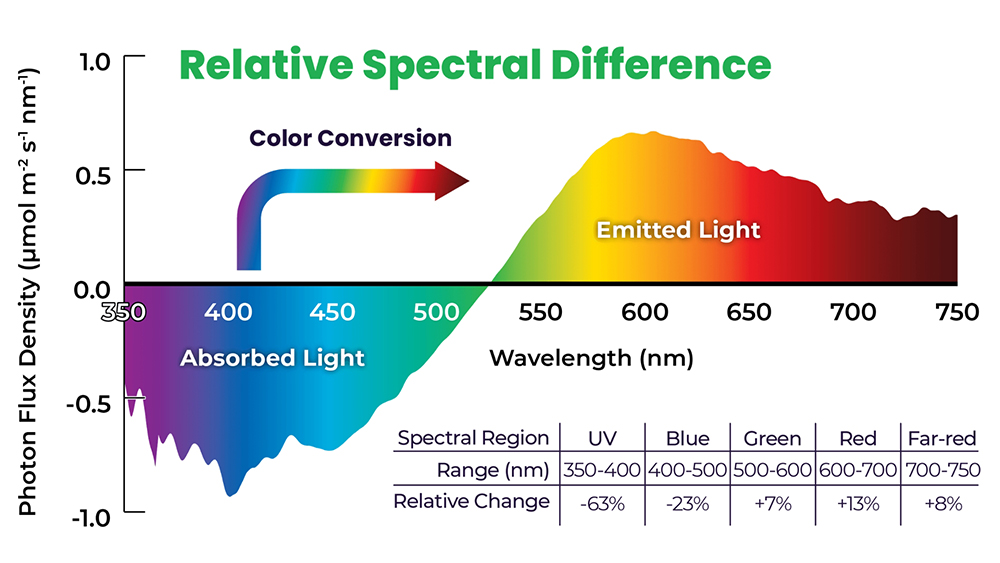
Relative spectral difference graph showing quantum dot color conversion from UV/blue absorption to orange/red emission.
- Photoluminescent Conversion: Quantum dots absorb underutilized UV and blue photons and convert them into peak photosynthetic orange and red light.
- Diffuse Light Penetration: The film scatters direct solar rays into omnidirectional, diffuse light. Diffuse photons wrap around plant structures to reach lower leaves, improving whole-canopy light distribution.
- Standard 4-Year Poly Integration: The film installs exactly like a typical greenhouse poly covering. It requires no specialized expertise, structural modifications, or operational downtime, and it delivers the same reliable 4-year lifespan as standard cover films.
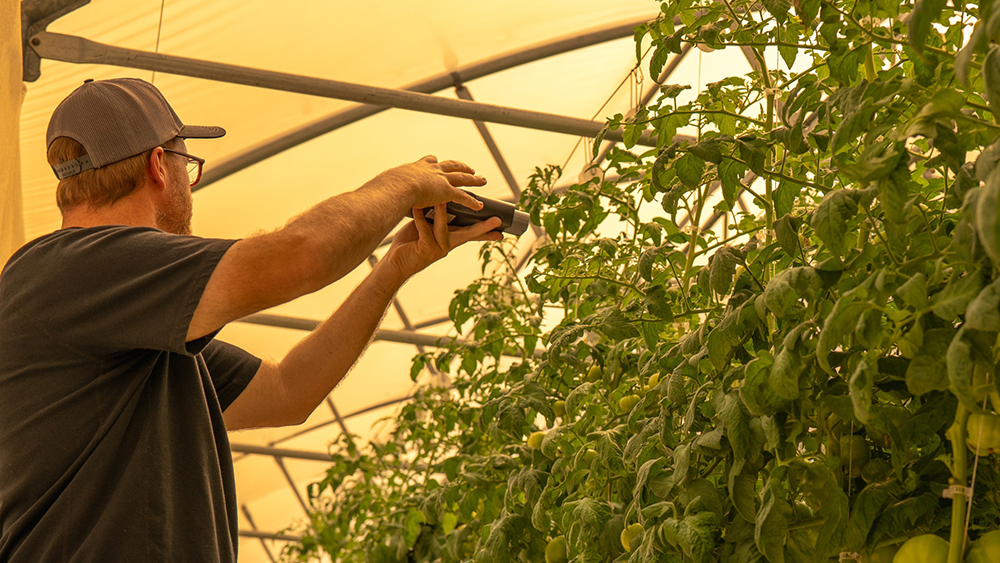
Grower inspecting greenhouse tomato canopy under diffused, spectrum-shifted orange light.
Proven Production Gains
By passively optimizing the free sunlight already reaching your greenhouse, UbiGro delivers potential yield increases of up to 30% across commercial produce and botanical crops at pennies on the dollar compared to LED buildouts.
To review commercial trial results and calculate a custom light plan for your facility, visit UbiGro.