2025 Innovator Finalist: Sam Bertram, OnePointOne
 September 30, 2025
Sam Bertram is one of three finalists in the Innovator category of the inaugural CEAg World Impact Awards.
 Sam Bertram of OnePointOne in Scottsdale, Ariz., is one of three finalists in the Innovator category of the inaugural CEAg World Impact Awards. The Innovator Award recognizes an entrepreneur or leader who has pioneered and implemented a new tool, concept, or practice that has significant implications for CEA. This award recipient will be someone who has used their expertise to drive tangible improvements for growers, enhancing productivity, sustainability, and overall farm success.
Learn more about Bertram below and watch CEAgWorld.com for more profiles of our finalists.
As CEO of OnePointOne, Sam Bertram has spent eight years navigating the complex challenges of vertical farming. He and his brother John founded OnePointOne in 2017 with the ambitious goal of transforming food production to solve global food insecurity. But the early years were characterized by attempts to develop proprietary technology across multiple fronts simultaneously. It was the wrong approach.
“We jammed the company full of engineers, and that was my fault,” Bertram acknowledges. “It’s extremely hard to develop 10 to 15 new technologies and then have them work at scale immediately. We had to put our ego in the back pocket and say, you know, all of that stuff is incredible, but it’s nowhere near as good as I thought.”
This stark (and expensive) realization led to a fundamental strategic pivot. Rather than continuing to develop custom systems, OnePointOne partnered with AutoStore, a Norwegian warehouse automation company, to create Opollo Farm.
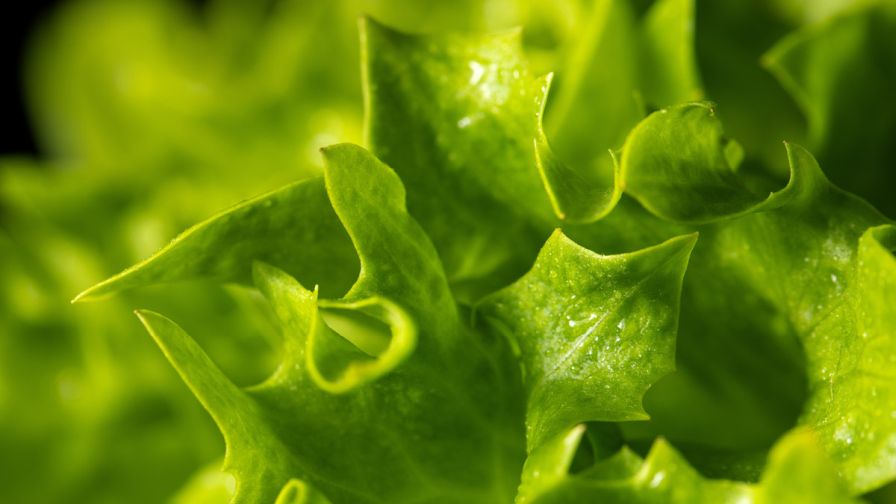
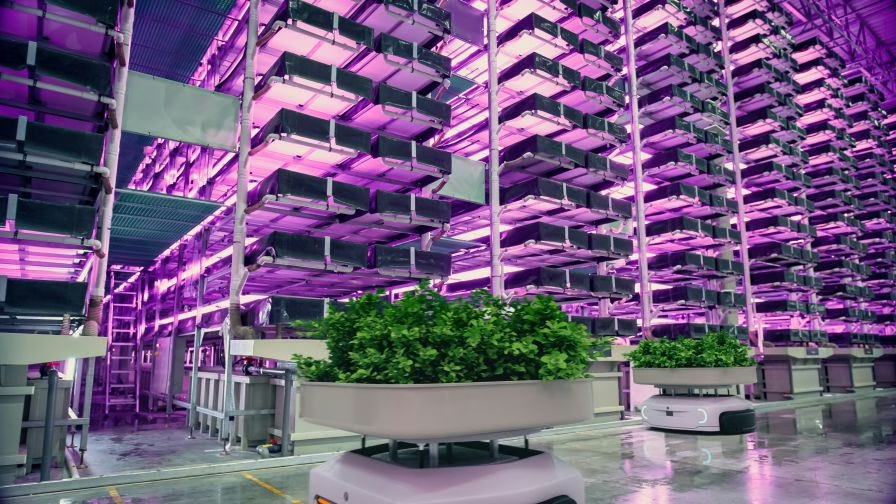
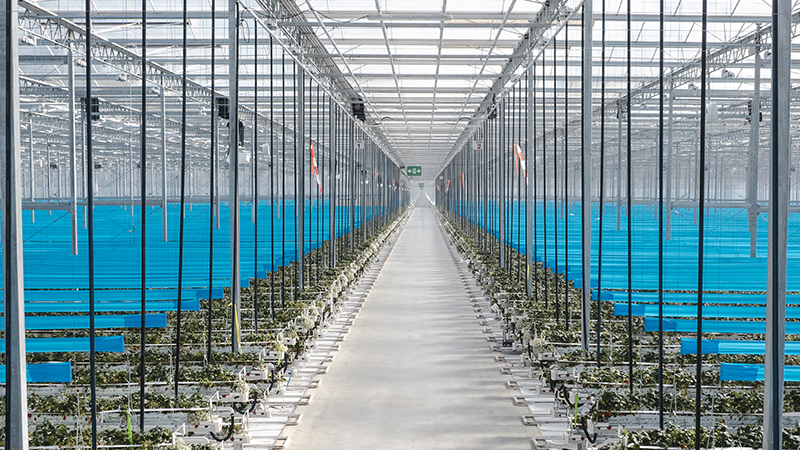
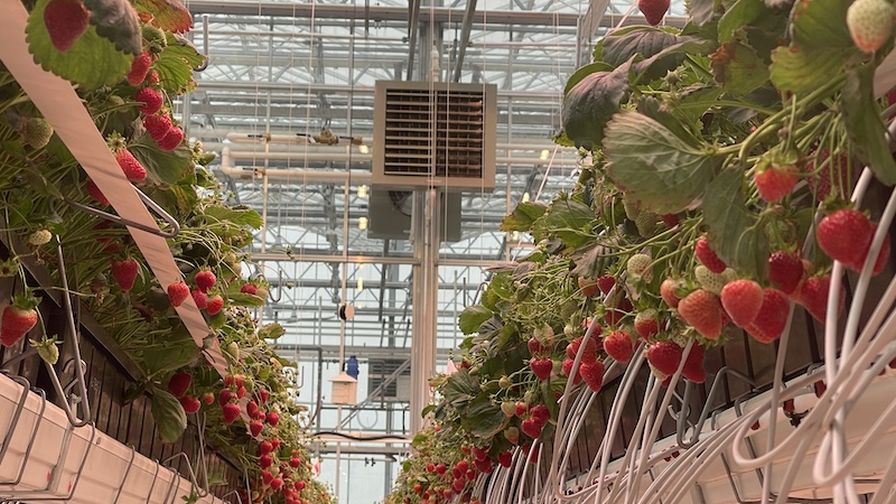
Opollo Farm is currently optimized for leafy greens, microgreens, and the production of some herbs. | Photo courtesy of Sam Bertram
Fully Automated and Modular
Officially launched in Scottsdale, Ariz., in May 2025, Opollo Farm grows greens and herbs that it distributes under the brand name Willo to all Whole Foods stores in Arizona. The patented farm system is built on the AutoStore cube-storage framework—normally used in e-commerce warehouses to store bins—which has been repurposed so that each bin holds plants instead of products.
A grid of robotic shuttles moving along the top delivers those bins to fully automated workstations for seeding, monitoring, and harvesting. AI and sensors manage growth conditions inside the structure, and the system is customizable for different crops.
“The farm has been optimized for leafy greens, microgreens, and the production of some herbs,” Bertram says. “The same system and the same dimensions can be used for mushrooms and strawberries, which are both in our near future.”
AutoStore has been building and improving its automated grid commercially for over 20 years, with more than 1,700 systems running worldwide today. “It’s super modular, super scalable. You can have a 1,000-square-foot facility with two robots, or you can have a 200,000-square-foot facility with a thousand robots. Both of those use cases work,” Bertram says. With that foundation and proven scalability in place, he can focus on more practical matters: unit economics.
“We’re just ironing out the edges of the system to optimize it for plant production,” he says. “I could bore you for an hour about the different things we’re doing to make the plants grow better. But our perspective is, innovate only where you need to.”
Focus on Costs
Bertram’s vision centers on customizing and selling the Opollo Farm systems directly to retailers and distributors, so they can install them inside their own distribution centers. “They own it,” he says, “so the product comes out of the farm every day, goes directly into cold storage, and then right into the retail distribution chain. You can cut out the entire leg of transportation.”
At the root of realizing any and all of these goals, Bertram says, is cost management. Rather than pursuing incremental improvements with minimal impact, he focuses on innovations that deliver measurable cost reductions. “For now, innovation is pivotal insofar as it drives costs down,” he says. “I’m not going to spend a huge amount of time or money trying to innovate [on endeavors] that aren’t going to improve my unit economics by 5 or 10%.”
Future Game Changers
Looking ahead for the future of CEA productivity, Bertram identifies genetics and energy as areas with the biggest potential for game-changing improvements. He advocates for increased experimentation with plant genetics to improve photosynthetic efficiency: “Plants don’t absorb most of the light that hits them. Solar panels are more efficient than plants.”
He’d also love to see vertical farms co-located with nuclear power plants or other low-cost energy sources, potentially accessing electricity at 3-5 cents per kilowatt hour. Such arrangements could fundamentally alter the economic equation for vertical farming, he says, making it competitive with greenhouse production for a broader range of crops.
Thinking Big
Talking to Bertram, it seems that he thrives in the weeds, eager to keep pushing for the exact combination of calibrations that will unlock vertical farming’s widespread adoption. He offers a few hints toward OnePointOne projects in the works—nutritional testing, airflow improvements in a highly dense environment—and then nods to the big picture.
“I’m very excited about the technical innovations that we’re bringing to bear in partnership with AutoStore,” he says. “But I’m most excited about taking those innovations from 1 to 10 in terms of scale. All of the headaches that are going to come from scaling that to 10 … I can’t wait for them.”
The winners of the CEAg Impact Awards will be announced and honored live on stage at the kickoff ceremony for the CEAg World Conference and Expo on Nov. 20, 2025, in Durham, N.C. To learn more and join us at the conference (growers attend free if registered by Oct. 31), visit CEAgWorld.com/events.