RII Analyzes Greenhouse Colocation and Resource Sharing in New Guide
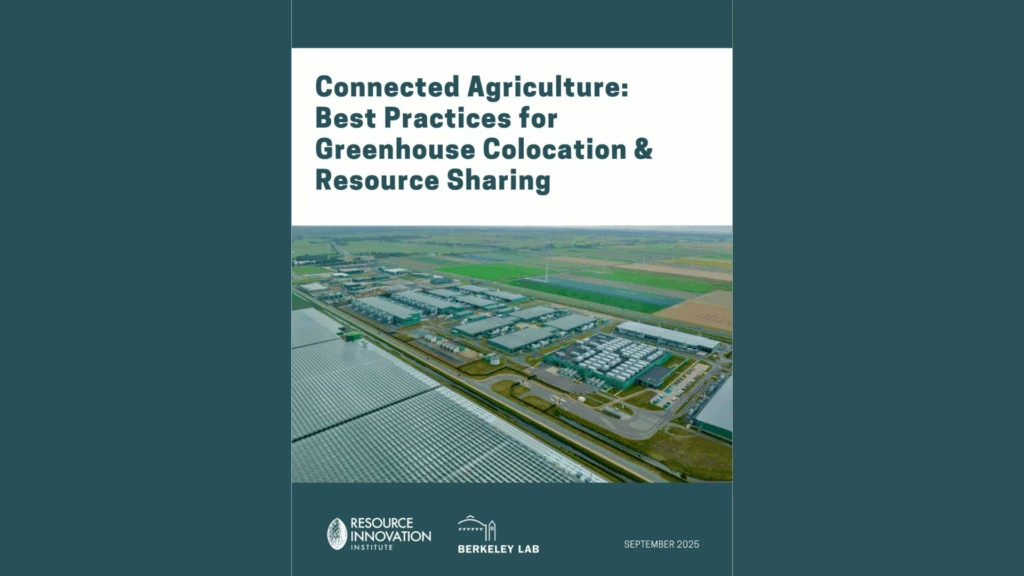
Cover of the “Connected Agriculture: Best Practices for Greenhouse Colocation & Resource Sharing” guide from RII. | Photo courtesy of RII
Rising utility expenses and growing uncertainty around CO2 availability are pushing greenhouse operators to reconsider how they approach facility planning. “Connected Agriculture: Best Practices for Greenhouse Colocation & Resource Sharing,” a recent analysis from Resource Innovation Institute (RII), explores whether sharing infrastructure with complementary businesses could address these challenges.
Three Paths Forward
The guide identifies three colocation models, each with different scales and complexity levels.
- One-to-one partnerships involve direct relationships between growers and single partners (e.g., breweries providing fermentation byproducts or industrial facilities offering excess thermal output). While straightforward to negotiate, these setups often struggle because greenhouse needs fluctuate seasonally, while partner facilities operate on different schedules.
- District utility systems resemble college campus utilities, where central plants serve diverse users through shared networks. Multiple customers create steadier demand patterns and support investments in storage capacity and redundant equipment that individual buildings cannot justify alone.
- The “Farm Park” model. These large-scale, integrated developments represent the most ambitious model, clustering food production with processing, logistics, and complementary industries around centralized utility hubs. The Dutch Agriport A7 complex exemplifies this concept, combining extensive greenhouse acreage with technology facilities and supporting businesses to create what amounts to an agricultural industrial park.
Implementation Challenges Remain
While these colocation models are promising, financial hurdles remain substantial. Shared systems require significant construction investment before operations begin, and determining fair cost allocation among diverse participants creates complications. Facilities with mission-critical operations cannot accept supply interruptions, forcing continued investment in backup capacity that reduces projected savings.
In addition, permitting complexity varies dramatically by jurisdiction, with regulatory inconsistency adding substantial transaction costs. Local authorities sometimes misapply industrial standards to agricultural operations when facilities are located adjacent to non-farm businesses, creating unnecessary compliance issues.
Lastly, market perception requires careful management, as consumers may question product quality from facilities sharing sites with data centers or manufacturing operations, regardless of technical safeguards.



Economic Models Evolve
Third-party infrastructure ownership emerged as a promising approach to funding, as it allows companies to build and operate central systems while individual facilities purchase services through contracts. This structure reduces capital requirements for growers while transferring technical and operational risk to entities with relevant expertise.
RII’s analysis suggests that success depends on achieving sufficient scale to justify sophisticated infrastructure while developing frameworks that balance shared efficiency against individual facility autonomy. As renewable energy penetration increases grid instability and thermal storage technology improves, the business case for coordinated developments continues to grow stronger.
To download the full report, go to http://bit.ly/4849lPB.