Expert Roundtable: The Way Forward for Vertical Farming
 May 4, 2026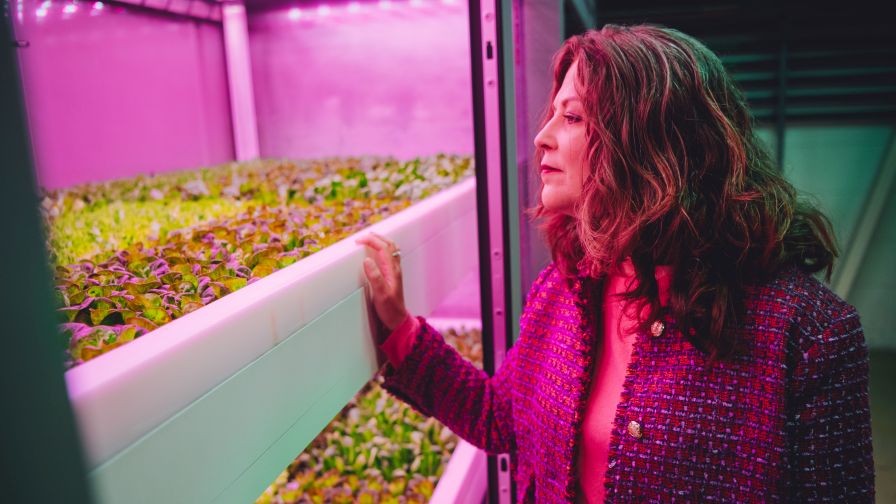
80 Acres Farms has been cautious and methodical as it scales across the United States. | 80 Acres Farms
The companies invited to participate in this roundtable discussion are likely familiar to you already, but it’s worth a brief introduction to set the stage:
Hamilton, Ohio-based 80 Acres Farms operates a network of large vertical farms producing leafy greens, microgreens, and herbs for national retailers and foodservice customers. It’s a rare example of vertical farming success at scale, with the company growing through disciplined operations, acquisitions, and product diversification.
Plenty started out with a similar diversified, operator-led model but struggled to scale economically, filing for Chapter 11 restructuring in 2025. It emerged with a singular focus on strawberry production via its Virginia facility, with an exclusive downstream partnership with category giant Driscoll’s.
OnePointOne in Scottsdale, Ariz., is developing highly automated vertical farms built on proven warehouse robotics platforms, which it sells to retailers, distributors, and others to allow them to run their own production facilities. The long-term vision is to colocate the farms at or near distribution centers to plug directly into existing supply chains.
And Growcer, out of Canada, focuses on food security, decentralization, and extreme-climate resilience. It supplies and provides ongoing support for container farms for local operation, a strategy it significantly expanded worldwide through the recent acquisition of Freight Farms’ assets following that company’s shutdown.

The differences are significant. But the similarities, as they emerged through the conversation, are telling. All the participants have worked in vertical farming for years, monitoring and weathering the sector’s volatility and applying hard-earned lessons to build better, smarter approaches. Their insights below provide a compelling look at how vertical farming operations might succeed going forward, regardless of the business model.
Kristin D. Zeit, CEAg World: What are the most persistent misconceptions you hear around vertical farming?
Dan Malech, Plenty: I’ll start by acknowledging that the bears on vertical farming from five years ago were right on a few things. There have been challenges in the sector, and the approach that many of us were taking, including Plenty, needed some refinement.
But it’s a different landscape and a pretty different set of strategies now. I’ve heard the critique that vertical farming companies are just a bunch of Silicon Valley technologists who’ve never gotten their hands dirty or stepped in a field.
But Plenty—and the other panelists, too—we all have deep benches of folks with ag industry expertise. We’ve got growers with 20 to 30 years of experience growing in all kinds of systems.
Tisha Livingston, 80 Acres Farms: There are a couple of misconceptions that absolutely make me crazy. One is that vertical farming is primarily a technology play. In reality, success comes from running a disciplined food manufacturing and consumer products business. Technology is just one component of it, or it’s an enabler. It helps us deliver differentiated products, but it isn’t the sole purpose of the company.
The other misconception is that vertical farming is striving to match commodity products from the open field or in the greenhouse. There are easier ways to grow a commodity product than through a vertical farm. Our goal is to decommoditize produce and deliver something different.
Sam Bertram, OnePointOne: One persistent misconception is around nutritional content. Because it’s a machine growing something that’s alive, people assume we’re optimizing only for weight, as outdoor farms often do.
Weight is very important. Yield is very important. But they’re not necessarily all we’re optimizing for. Our goal is to differentiate ourselves in meaningful ways. And whether it’s by how quickly we can get the product to market after harvest, whether it’s by our growing methods, or whether it’s through our genetics selections with the plants: These plants are more nutritious.
Another misconception is around labor. Automate all you like, but it’s still a very labor-intensive process. Yes, conveyors and software integration and all that stuff is helping. But in order to maintain a high-quality product, a clean system, food safety standards, etc., you need people.
Corey Ellis, Growcer: When people say “vertical farming” in the public sphere, it tilts more toward large-scale, warehouse-style production. But there are a lot of subcategories that have very different operational realities and complexities, different needs and levers.
In our world, it’s very small-scale, very on-site production. So, while we’re all using similar technology, we’re actually running quite different businesses. My customers are not Sam’s customers or Tisha’s customers. We all have our own niches.
Another misconception is that vertical farming is not profitable today. We have several hundred clients that are cash-flow positive. They don’t have venture capital; they made an original investment, and they’re generating cash every day, every single week. But it takes a lot of discipline to get there, and it doesn’t work everywhere for everyone.
CEAg World: So, compared with other types of vertical farming, what conditions must be in place for each of your models to succeed?
Growcer: First is the right expectations. We give our customers average financials for what a Growcer farm performs at based on anonymized data. So, they go in knowing this is a typical labor cost, typical power consumption, typical yield.
From there, they need to take operational ownership. This isn’t a set-it-and-forget-it kind of software integration. You’ve got to be committed, and you’ve got to be able to react.
The right capital stack is really important, too: getting partners who understand what you’re trying to build. I don’t know of many customers that have any sort of private equity or venture capital at all to buy their Growcer farms. It’s largely been one source, their own capital on their balance sheet, or bank financing, like 10-plus-year amortization. “Patient capital,” if you will.
Where I’ve seen customers be very successful is when they understand who their consumer is, what their consumer is willing to pay, and what attributes the consumer is looking for. There is certainly a value to local production, at least in the markets we serve. It’s all about knowing how to price your product appropriately to maximize margin.
80 Acres: For our business, we need scale. We have a national footprint, and we need to be able to maintain our brand promise to our consumers and our customers. Having the infrastructure to support a bigger company, so that we can continue to deliver on time with consistency and high-quality products, is really important.
We were an $8 million company in 2021–2022, and now we’re $180 million over the course of less than 10 years. So, it’s a huge ramp-up. And we have to maintain that operational discipline. We’re manufacturing, from sowing and growing all the way to packing and processing. And so making sure that we’re thinking about our company in terms of standards and KPIs and managing the network is really important so that we can drive to profitability as a company and maintain it.
Mike [Zelkind, CEO of 80 Acres] and I started with our own money. We were always at least a cycle behind everybody else, and we raised only what was absolutely needed to be able to get to the next proof point.
We still try to have that scrappy startup mentality to this day, and I think you can see that even with the acquisitions we chose to make instead of building out our own technology. Others went out and placed bets on all these locations and bought all the equipment to be able to open five, 10 farms.
In 2023, Mike and I still had two farms, but we strove to sell those farms out and build relationships with the customers before building the next farm. Once we had the national contract with Kroger, then we were like, OK, we need more of a footprint because Kroger will scale with us. And that’s really when we started looking at acquisitions, which was incredibly capital efficient in my estimation.
Plenty: Our partnership with Driscoll’s has been absolutely essential for us on a number of fronts. One, they bring things to the table that we don’t have. Being able to work with them with their world-class genetics, scientific talent, and branded marketing has been hugely accretive for both of us.
I’m focused on running the company super efficiently and disciplined going forward, so it’s key to have a partner that already has the distribution, is great at logistics, knows how to market, has an established brand presence, and has an established and very capable sales function. So, I don’t need to focus as much on those things. I’d much rather focus on making a perfect strawberry than getting really great at logistics, right? So, it’s hugely valuable as far as that goes.
Proprietary technology has been key for us, as well. Part of the strategy is counter-positioning: What is the market missing today that we think there’s a demand and a need for? And the technology is really the key to being able to do that.
All of those things are necessary. And if you don’t have the scale, if you don’t have the reliability, you don’t have the product itself, then the strategy falls apart.
And then there’s the specialty around a single crop. Again, it comes back to focus, focus, focus. Until we’ve proven ourselves and really nailed that first product, we haven’t really earned the right to play on other things.
It’s pretty easy to delude yourself that you can walk and chew gum at the same time, but being able to focus day in and day out, to not have mixed priorities, and everybody’s 100% clear on what’s important—I think that’s essential for success.
OnePointOne: We learned the hard way to keep your blinders on. There are so many interesting opportunities, but you’ll just end up chasing every rabbit down the wrong hole, and then you’re dead.
We tried to do too much at once, and that could have been our downfall. We started developing our own warehouse automation system, and then we realized there are much, much better systems already out there. So, we took one, and we turned it into a farm.
Now we focus on the areas where we need to innovate, where innovation and invention are necessary. LED lighting, HVAC, irrigation, ASRS [automatic storage and retrieval systems]—there are already pretty big solutions out there that we just need to integrate.
But operational excellence is really what it comes down to at the end of the day. And doing that every day is something that requires a lot of endurance and the right people. Right now, we’re growing stuff that’s green, stuff that consumers want. And once we’re optimized for other categories of crops, then we’ll start to very, very slowly enter into those.
CEAg World: How does location factor into your strategy?
80 Acres: When we first started in 2015, everybody talked about rooftop vertical farms or being in buildings right in the cities. That didn’t feel practical just because of the transportation. If you have to deliver to individual restaurants and small grocery stores, that’s very expensive and a completely different business model than focusing on growing produce that you distribute. So, for us, location is all about population centers and close proximity to our retailers and foodservice distribution centers.
We’re also looking for the right utility rates. In the U.S., prices depend on where you are, and in some cases, you can be across the highway and have a very different rate.
And then also availability of labor, because as Sam mentioned, you still do need a significant number of people operating these farms.
Plenty: You want to be close to your consumers, and you want to be close to attractive factors of production. We chose where we did in Virginia for a number of reasons. One, because it reaches about 100 million consumers within one day’s shipping distance.
Power is a big input cost, and then proximity and access to labor are important, as well; where we are in Richmond is quite attractive for both of those fronts, as are the great partnerships we’ve gotten from the state and the county.
OnePointOne: Unless something dramatic changes in the U.S., large-scale vertical farms are always going to be in places where electricity prices are low, labor is available, rental prices are low, and you’re very close to distribution centers.
Growcer: Our situation is a bit unique in that our customers [e.g., grocery stores, large cafeterias, schools, Native communities] provide the location. But what location gets our customers is freshness. They’re investing in this technology because they’re ultimately trying to buy an outcome for the end consumer. By co-locating, you get peak freshness. You don’t have any shrink from transportation.
There’s also the sales and marketing component. The farm is like a 40-foot billboard in the parking lot, and it’s the middle of February and cold, but you’re still bringing fresh greens onto the shelf. That’s hard to measure, but still a very real element of customer loyalty and attracting new shoppers.
CEAg World: What milestones will make vertical farming more viable as a food-system solution for North America?
Plenty: Vertical farms need to be a solution to a problem. Figuring out your focus, where you’re adding value, and whether there’s a market for that is going to be critical to success. You can’t be a commodity product.
We also need unit economics that make sense for the product you’re selling. You’ve got to charge the right amount. It can be higher than what the other production system charges, as long as the value proposition and the market are there for it. But your unit economics need to match that, and that takes operational discipline. It takes pulling all the levers you have to make it work.
And then finally, I think supportive partnerships in both the private and public sector, that’s really important and is going to be key.
OnePointOne: You know, with the introduction of MAHA [the federal “Make America Healthy Again” initiative] and the focus on domestic production, I honestly thought this would be a stars-aligning point for the CEA industry. That the U.S. government would be like, “All right, this is really important to us, let’s juice it.”
The opportunity for a locally grown, super-nutritious product—and to dodge imports—I would think from the government’s perspective, one of the main things we could do is try to onshore a lot of the manufacturing of food. But it’s been surprising how little emphasis there’s been on that.
80 Acres: Well, there’s a bit of a stink around vertical farming. When you look at the loans around USDA, they’ve had a couple of really embarrassing situations. And I think people are gun-shy.
So, while I agree with you that [vertical farming] is a huge advantage, as an industry, we haven’t proven that it’s a stable enough solution to make an impact.
I think it can play as a significant contributor to the food security issue. But until we significantly get out of leafy greens and microgreens and really start talking about substantial food… for me, it’s crawl, walk, run.
We know how to grow the crops. We know how to make money at it. We know how to steer the crops for certain nutrition. Now we have to build on what makes sense to grow in a vertical farm and still make profitability, and then we’ll be able to talk about impacting food security.
Growcer: In Canada, it’s kind of the opposite. Our government recently announced they were going to double down on a major campaign to bring more infrastructure for domestic food production. So, if you’re a high-net-worth individual investing in a company like 80 Acres, you get a full tax deduction for your investment. The projects they’ve done since 2020 have actually gone quite well and returned a lot of the money that was lent.
But the other factor is that Canada is 85% import-dependent for its lettuce, leafy greens, etc. I haven’t seen the latest stats, but I think the U.S. produces 80% of its own lettuce, and only depends on 20% for imports. So, it could get to 100%, sure, but north of the border, we have a lot more work to do to become self-reliant.
Editor’s note: This article was originally published in our 2026 Industry Report: Vertical Farming.